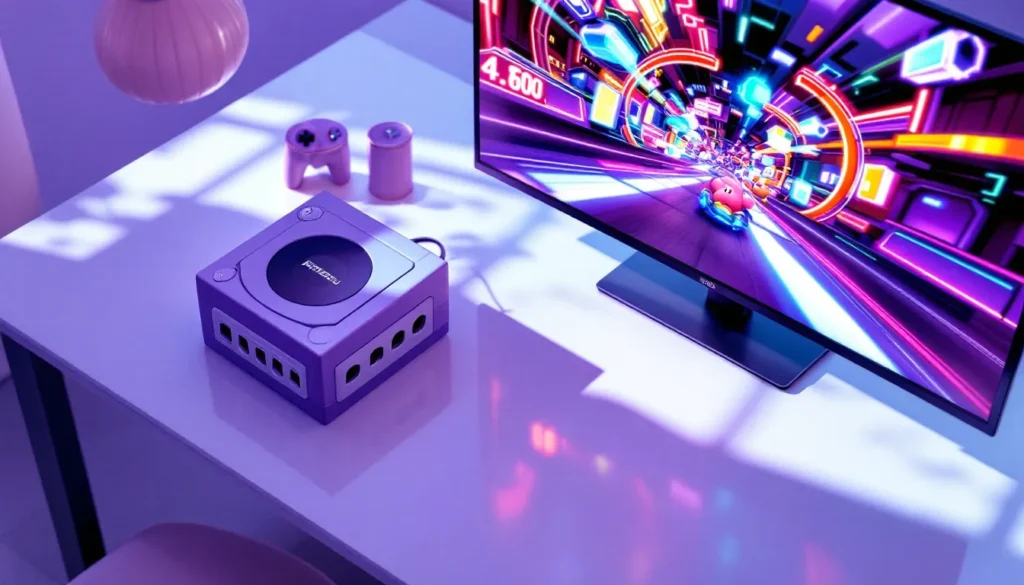
Back in 2003, HAL Laboratory dropped something unusual onto the GameCube: a racing game where you didn’t press a button to accelerate. Kirby Air Ride ditched everything gamers thought they knew about racing controls and bet everything on a single-button system. Critics were mixed. Sales were modest. But over two decades later, it’s become one of the most requested titles for a sequel or remaster in Nintendo’s entire catalog.
What happened? How did a game with a 61 Metascore transform into a beloved cult classic with dedicated communities still hunting for perfect checklist completion in 2026? The answer lies in City Trial, a freeform multiplayer mode that feels like a proto-battle royale mixed with Mario Kart chaos, and a deceptively simple control scheme that rewards mastery over button mashing. Whether you’re rediscovering this GameCube oddity or exploring it for the first time through emulation, this guide covers everything you need to know.
Key Takeaways
- Kirby Air Ride’s revolutionary one-button control system and City Trial mode transformed a 2003 cult classic into one of Nintendo’s most requested sequels despite modest initial sales.
- City Trial, the standout multiplayer mode, delivers unpredictable freeform exploration where players collect stat boosts and face random final events, rewarding strategy and adaptability over mechanical skill.
- The game’s 120-objective checklist system and legendary machines like the Dragoon create deep replayability and community-driven competition that has sustained engagement for over two decades.
- Mastering copy abilities, boost stacking, and course shortcuts separates casual players from skilled ones in Air Ride mode competitive play.
- Kirby Air Ride remains unavailable on modern platforms, driving fan demand for a sequel or remaster, with emulation via Dolphin offering the most accessible way to experience the game in 2026.
What Is Kirby Air Ride and Why It Remains a Cult Classic
Kirby Air Ride is a 2003 racing game developed by HAL Laboratory exclusively for the Nintendo GameCube. Unlike traditional kart racers, it features a revolutionary one-button control system where players use only the analog stick and A button to control their chosen Air Ride machine. There’s no dedicated acceleration, Kirby automatically moves forward. The A button handles everything else: charging boosts, copying abilities, and braking.
The game launched to mixed reception. Reviewers criticized its simplicity and lack of depth compared to Mario Kart: Double Dash, which released the same year. But the GameCube’s library was crowded with quality titles, and Kirby Air Ride got buried beneath Metroid Prime, The Legend of Zelda: The Wind Waker, and other heavy hitters.
So why the cult status? Three reasons. First, City Trial mode, more on that shortly, created emergent multiplayer moments that felt fresh every session. Second, the game’s 120-objective checklist system gave completionists a meaty challenge that kept them playing for years. Third, nostalgia kicked in hard around 2015-2018 when YouTubers and streamers revisited GameCube gems, introducing Kirby Air Ride to a new generation who never experienced it during its original run.
By 2026, the game sits in a strange position: unavailable for legal purchase on modern Nintendo platforms, yet widely discussed in forums dedicated to Nintendo Switch news and retro gaming communities. Its absence fuels demand. The longer Nintendo ignores it, the louder fans get.
Game Modes Explained: Air Ride, Top Ride, and City Trial
Kirby Air Ride splits into three distinct modes, each offering a different racing experience. Understanding how they differ is essential because each mode has unique unlockables and strategies.
Air Ride Mode: Classic Racing Action
Air Ride mode is the closest thing to a traditional racer. Players choose from nine courses and compete in standard lap-based races. Courses range from simple circuits like Fantasy Meadows to hazard-filled tracks like Frozen Hillside and Magma Flows.
What sets it apart? The copy abilities. Smashing certain enemies or item boxes grants Kirby temporary powers: Sword for slashing through obstacles, Tornado for speed bursts, Wheel for tighter handling, and Jet for airborne shortcuts. Mastering when to grab abilities versus when to save boost charge separates casual players from skilled ones.
Air Ride mode unlocks new machines by completing specific checklist objectives. For example, finishing Celestial Valley under a certain time unlocks the Turbo Star, a high-speed machine with poor handling. Each course has multiple checklist goals tied to it, encouraging replay.
Top Ride Mode: Old-School Overhead Racing
Top Ride mode switches to an overhead perspective reminiscent of classic arcade racers like Super Sprint or RC Pro-Am. The camera angle completely changes the gameplay, tight corners become trickier, and spatial awareness matters more than raw speed.
Honestly? Top Ride is the weakest of the three modes. It feels like a novelty addition that never fully realized its potential. The seven Top Ride courses are short, and the mode lacks the copy abilities that make Air Ride fun. Most players complete the Top Ride checklist objectives for completion’s sake, then rarely return.
That said, multiplayer Top Ride can get chaotic in a good way. The cramped overhead view makes it harder to see who’s in the lead, creating comedic pile-ups at choke points.
City Trial Mode: The Fan-Favorite Freeform Experience
This is it. This is why people still talk about Kirby Air Ride in 2026.
City Trial drops up to four players into a sprawling open city for seven minutes of freeform exploration. There’s no racing yet. Instead, players roam the city collecting power-ups that permanently boost their machine’s stats: Speed, HP, Glide, Turn, Charge, Attack, and Defense. Red boxes give stat boosts. Gold boxes contain powerful items like bombs or temporary invincibility.
Random events shake things up mid-session. A meteor shower might rain down stat boosts. A sudden gravity shift could flip the entire city upside-down. The Dyna Blade (a giant bird) might appear and attack players, but defeating it rewards massive stat gains.
After seven minutes, the game randomly selects a final event: a race, a battle royale, a glide competition, or a destruction derby. Your stat distribution determines how well you perform. If the final event is a race and you stacked glide/turn stats, you’re in great shape. If it’s a destruction derby and you ignored HP/attack, you’re toast.
City Trial’s brilliance lies in its unpredictability. Every session feels different. You might stumble onto a legendary machine like the Dragoon or Hydra hidden in the city, completely changing your strategy. Or you might spend six minutes grinding stats only to get wrecked by a well-timed bomb from another player in the final seconds.
The mode rewards exploration, risk assessment, and adaptability. It’s less about mechanical skill and more about reading the flow of the match, knowing when to fight over a legendary machine spawn versus when to quietly farm stat boxes in a forgotten corner of the city.
All Air Ride Machines: Stats, Unlocks, and Best Choices
Kirby Air Ride features dozens of machines, each with unique stat distributions. Choosing the right machine for the mode and objective makes a huge difference.
Starter Machines and How They Compare
You begin with access to several basic machines:
- Warp Star: The all-rounder. Balanced stats, easy handling, and decent top speed. Great for learning the game but outclassed once you unlock better machines.
- Compact Star: High acceleration, low top speed. Handles tight corners well but struggles on long straights. Ideal for technical courses like Beanstalk Park.
- Wagon Star: Slow but tanky. High HP and strong boost charge. Not recommended for racing, but useful in City Trial combat scenarios.
- Turbo Star: Unlocked early by completing a Celestial Valley time trial. Fast top speed, awful handling. The definition of a glass cannon, great for straight courses, a nightmare on anything with turns.
Most players gravitate toward the Warp Star or Compact Star until they unlock mid-tier machines. Don’t sleep on the Wagon Star for City Trial, though. Its high HP makes it surprisingly resilient during random events.
Legendary Air Ride Machines Worth Unlocking
The real fun begins when you unlock legendary machines. These are rare spawns in City Trial or tied to difficult checklist objectives:
- Dragoon: Appears randomly in City Trial. Absurdly high speed and glide stats. If you grab this early in a City Trial session, you’re heavily favored to win most final events. The catch? Other players will hunt you down to steal it.
- Hydra: Another City Trial legendary. Highest HP and attack stats in the game. Perfect for destruction derbies or combat-heavy final events. Slow and cumbersome for races.
- Shadow Star: Unlocked by clearing all Air Ride checklist objectives on Hard difficulty. Balanced stats across the board with slightly higher speed than the Warp Star. Essentially the “postgame Warp Star.”
- Rex Wheelie: A bizarre machine that looks like Kirby riding a dinosaur. High boost power but poor glide. Fun for messing around, not competitive.
- Slick Star: The speed demon. Fastest acceleration in the game but paper-thin HP. One collision can end your race. High-risk, high-reward.
For competitive Air Ride mode racing, the Slick Star and Turbo Star dominate once you master their handling quirks. For City Trial, it’s all about adapting to what you find, but if the Dragoon spawns, drop everything and go get it.
Many dedicated players reference tier lists and meta analysis to optimize their machine choices for specific challenges, especially when hunting down the toughest checklist objectives.
Mastering Controls: The One-Button Revolution
Kirby Air Ride’s control scheme sounds gimmicky on paper. In practice, it’s elegantly simple and weirdly deep.
Here’s the full control layout:
- Analog stick: Steer Kirby and his machine.
- A button (tap): Perform a quick turn or drift. Use this to take tight corners without losing much speed.
- A button (hold): Charge a boost. The longer you hold, the stronger the boost when you release. But you’re slowing down while charging, so timing is everything.
- A button (while airborne): Glide. Releasing A ends the glide and gives you a small speed burst on landing.
That’s it. No B button. No triggers. No complex drift mechanics like Mario Kart’s mini-turbos.
The genius lies in resource management. Do you charge a boost before a long straightaway, sacrificing speed now for a burst later? Or do you tap A repeatedly to quick-turn through a technical section, maintaining momentum? Every decision has a trade-off.
Copy abilities add another layer. When Kirby inhales an enemy or grabs an ability box, the A button’s function changes:
- Sword: A button slashes, destroying obstacles and cutting corners.
- Parasol: A button extends glide time significantly.
- Wheel: A button activates a speed boost with improved handling.
- Stone: A button drops Kirby like a rock, smashing through enemies but killing all momentum.
The best players know exactly which abilities to grab on which courses. Jet ability on Frozen Hillside opens up a massive shortcut over the central ice pit. Parasol on Sky Sands extends glides across huge gaps. Ignoring copy abilities is a rookie mistake.
One advanced technique: boost stacking. If you release a charged boost right as you hit a speed pad or grab a boost item, the effects multiply. It’s frame-tight and hard to pull off consistently, but it can shave seconds off lap times.
Unlocking Everything: Checklist System and Achievement Guide
Kirby Air Ride’s checklist system is the backbone of its longevity. There are 120 objectives total, split across the three modes. Completing checklist squares unlocks new machines, courses, music, and cosmetic options.
Essential Checklist Objectives for Beginners
When you first boot up the game, focus on these early objectives to unlock core content:
- Complete three laps on any Air Ride course (any difficulty): Unlocks additional courses.
- Play City Trial for the first time: Unlocks the Free Run option in City Trial, letting you explore the city without a time limit.
- Destroy 20 enemies in a single Air Ride race: Unlocks the Meta Knight difficulty option, which amps up AI aggression and is required for several advanced unlocks.
- Finish 1st place in a Top Ride race: Unlocks the next Top Ride course.
- Find a legendary machine in City Trial: Unlocks that machine in the selection menu for Free Run mode.
These early objectives are straightforward and designed to introduce you to each mode’s mechanics. Knock them out first to expand your options.
Advanced Checklist Challenges for Completionists
The final 20-30 checklist objectives are brutal. These are designed for players who’ve sunk 50+ hours into the game:
- Complete all Air Ride courses under target times on Meta Knight difficulty: This requires intimate knowledge of shortcuts, ability spawns, and boost timing. Magma Flows and Frozen Hillside are particularly unforgiving.
- Achieve a combined stat total of 200 in City Trial: You need absurd RNG luck or near-perfect routing to hit this. Red boxes give 3-5 stat points each, so you’ll need to grab 40+ boxes in seven minutes while avoiding damage.
- Destroy 1,500 total enemies across all modes: A pure grind. Most players chip away at this naturally over time.
- Unlock all Air Ride machines: Requires completing most other checklist objectives first. The final machine unlocks are tied to the hardest challenges.
- Play 100 City Trial sessions: Another grind, but City Trial is fun enough that this happens organically if you’re playing with friends.
The checklist UI shows which objectives you’ve completed with a stamp. A fully completed checklist board is a badge of honor in the Kirby Air Ride community. Screenshots of completed boards still pop up on gaming subreddits in 2026, usually accompanied by “Finally did it after 23 years” or similar captions.
Multiplayer Tips and Strategies for Competitive Play
Kirby Air Ride shines brightest with four players crowded around a GameCube. Whether you’re racing in Air Ride mode or brawling in City Trial, these strategies separate winners from also-rans.
Air Ride Mode Multiplayer:
- Abuse copy abilities aggressively. In multiplayer, stealing a Sword or Wheel ability right before a key section denies your opponents the advantage. It’s not dirty, it’s smart.
- Learn the shortcut on every course. Celestial Valley has a Jet ability spawn near the second checkpoint that opens a massive shortcut over the central gap. Magma Flows has a hidden tunnel accessible only with high glide. Know these and use them.
- Target the leader. If someone pulls ahead, gang up. Use the Bomb ability or Attack stat boosts to knock them off their machine. Kirby Air Ride rewards chaos.
City Trial Multiplayer:
City Trial is where the real mind games happen.
- Control legendary machine spawns. The Dragoon and Hydra spawn in fixed locations but at random times. If you know the spawn points (northeast tower for Dragoon, southwest underground for Hydra), camp them when you hear the spawn jingle.
- Sabotage is king. Got a bomb item? Save it for the final minute when everyone’s stat-stacked machines are grouped together. One well-timed bomb can reset an opponent’s entire session.
- Diversify your stats. Don’t over-invest in one stat unless you know the final event. A machine with 50 Speed and 5 Glide will lose a glide competition. Aim for balanced 20-30 across Speed, HP, and Glide until the final event is announced.
- Events dictate strategy. When the two-minute warning appears, the game gives a hint about the final event. If it’s a race, prioritize Speed and Turn boxes. If it’s a battle, hunt for HP and Attack. The final two minutes are more important than the first five.
- Destroy rivals’ machines if possible. If an opponent is riding a legendary machine or has stacked stats, attack them relentlessly. Breaking their machine forces them to respawn on a default Warp Star, resetting all their stat gains.
One specific tactic: the late-game legendary snipe. If you’re behind on stats with two minutes left, ignore stat boxes entirely and hunt for legendary machine spawns or the player who found one. Stealing a Dragoon at the six-minute mark can flip the entire match.
Why Kirby Air Ride Never Got a Sequel (And the Fan Demand for One)
It’s 2026. We’ve had eight Mario Kart games, countless Smash Bros. entries, and even a new F-Zero after a 20-year drought. So where’s Kirby Air Ride 2?
The answer is complicated. First, the original game sold only 1.21 million copies worldwide, respectable but nowhere near Mario Kart: Double Dash’s 7 million. Nintendo is a business, and 2003’s sales numbers didn’t scream “make a sequel.”
Second, HAL Laboratory, the developer, has been fully focused on mainline Kirby platformers. The studio releases a new Kirby game almost every year, and those consistently sell 2-4 million copies. From a resource-allocation perspective, why pull developers off a proven formula to revisit a niche racing spinoff?
Third, Masahiro Sakurai, the game’s director, moved on to Super Smash Bros. full-time after Air Ride. He left HAL Laboratory in 2003, and much of Air Ride’s design philosophy came from his vision. Without Sakurai, there’s no clear creative lead to helm a sequel.
But fan demand? It’s relentless. Petitions for a sequel or Switch port pop up every few months. Social media campaigns spike whenever Nintendo announces a new Direct. The “#KirbyAirRide2” hashtag trends periodically.
Nintendo has acknowledged the demand in vague terms. In a 2022 interview, a HAL producer mentioned they’re “aware of the love for Air Ride” but gave no commitments. The game’s absence from Nintendo Switch Online’s GameCube library (if/when that ever happens) is another sore point for fans.
Realistic prediction for 2026 and beyond? A full sequel seems unlikely unless Nintendo experiments with smaller-scale spinoff revivals. A remaster or port bundled with quality-of-life improvements, online multiplayer, widescreen support, additional City Trial maps, is more plausible. But until Nintendo makes a move, Kirby Air Ride remains frozen in GameCube amber, beloved but unavailable.
Playing Kirby Air Ride in 2026: Emulation and Alternatives
Since Nintendo hasn’t re-released Kirby Air Ride on modern platforms, players in 2026 have limited options for experiencing the game.
Option 1: Original GameCube Hardware
If you still own a GameCube and a copy of Kirby Air Ride, you’re golden. Prices for physical copies have climbed steadily, expect to pay $60-$100 USD for a complete-in-box copy as of 2026. Loose discs go for slightly less.
GameCube’s component cables provide a decent visual upgrade over composite, but the game still outputs at 480p max. Don’t expect miracles on modern 4K displays.
Option 2: Dolphin Emulator
Dolphin is the go-to GameCube and Wii emulator, and it runs Kirby Air Ride flawlessly on mid-range PCs. Enhancements include:
- Upscaled resolution (1080p, 1440p, or 4K)
- Anti-aliasing and texture filtering for crisper visuals
- Save states for checklist grinding
- Netplay support for online multiplayer (requires port forwarding and some setup, but it works)
Dolphin’s netplay feature has breathed new life into Air Ride’s multiplayer. Small communities organize City Trial netplay sessions regularly. Latency can be an issue depending on player locations, but for casual matches, it’s playable.
Legal note: Emulation sits in a gray area. Downloading ROMs is illegal if you don’t own the original game. Dolphin itself is legal, and ripping your own GameCube discs is technically legal for personal use.
Option 3: Similar Games
If you can’t access Kirby Air Ride but want a similar experience, try:
- Mario Kart 8 Deluxe (Switch): Obvious choice for kart racing, but it lacks City Trial’s freeform exploration.
- Splatoon 3’s Tableturf Battle (Switch): Not a racer, but the card-based strategy mode scratches a similar itch for Nintendo fans wanting something different from the main game.
- Chocobo GP (Switch): A chaotic kart racer with Final Fantasy flair. It has some freeform elements but leans heavily into gatcha mechanics.
Honestly? Nothing replicates City Trial. That mode’s unique blend of open-world stat hunting and random final events hasn’t been copied by any other game. The closest spiritual successor might be indie games like Horizon Chase Turbo for retro racing vibes, but they’re fundamentally different.
For those exploring retro Nintendo titles and considering emulation routes, communities dedicated to game walkthroughs often provide setup guides for specific emulator configurations.
Conclusion
Kirby Air Ride wasn’t the GameCube’s best-selling racer. It wasn’t the highest-rated. But it carved out a legacy that outlasted countless higher-profile titles through sheer originality. The one-button control scheme that reviewers mocked in 2003 is now celebrated as a bold design choice. City Trial, dismissed as a side mode, became the game’s defining feature.
In 2026, the game exists in a strange limbo, unavailable officially, yet culturally alive through emulation, community events, and relentless fan demand. Whether Nintendo ever delivers a sequel, remaster, or port remains to be seen. Until then, dust off that GameCube, fire up Dolphin, or keep refreshing Nintendo Directs for news that might never come.
Because if there’s one thing Kirby Air Ride players know, it’s how to wait for a long shot to pay off. After all, they’ve been grinding that checklist for over two decades.