
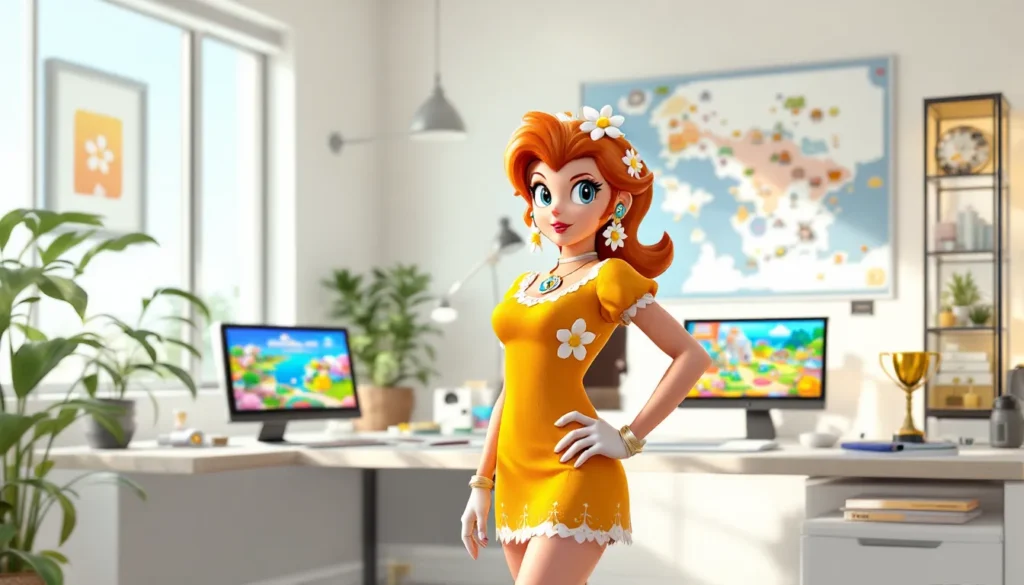
Princess Daisy has been part of Nintendo’s roster for nearly four decades, yet she’s never headlined her own mainline game. While Peach gets kidnapped in nearly every core Mario title and Rosalina commands her own galaxy, Daisy’s been relegated to the party circuit, karting, golfing, and tennis-ing her way through spin-offs since 1989. But here’s the thing: she’s built a fiercely loyal fanbase who appreciate her tomboy energy, competitive edge, and unapologetic personality. If you’ve ever wondered why Daisy shows up in Mario Kart but not in main platformers, or what makes her different from Peach beyond the orange dress, this guide breaks down everything you need to know about Sarasaland’s ruler. We’re covering her origins, every major game appearance, stat breakdowns for competitive play, and why 2026 might be the year Nintendo finally gives her the spotlight she deserves.
Key Takeaways
- Princess Daisy has built a fiercely loyal fanbase since her Super Mario Land debut in 1989, but remains the only major princess in Nintendo’s roster without a mainline solo game.
- Daisy differentiates herself from Princess Peach through her tomboyish personality, competitive edge, and athletic design—making her the go-to character for players seeking energetic, confident gameplay.
- In Mario Kart 8 Deluxe and Mario Kart Tour, Daisy’s mid-tier stats and strong handling make her versatile on technical tracks, while her Yukata variant dominates competitive ranked play with its Coin Box special item.
- As a Super Smash Bros. Ultimate Echo Fighter, Daisy shares identical frame data and movesets with Peach, but her animations offer unique visual flair and appeal to players who prefer her energetic fighting style.
- The #GiveDaisyAGame community movement, supported by 50,000+ petition signatures and sustained fan creativity, demonstrates strong demand for a Daisy-led adventure exploring Sarasaland’s unexplored kingdoms.
- Daisy represents personality diversity in Nintendo’s female character roster, resonating with players who identify with her competitive, assertive traits and breaking the traditional princess archetype.
Who Is Princess Daisy in the Nintendo Universe?
Origins in Super Mario Land and Early Appearances
Princess Daisy debuted in Super Mario Land (1989) for the original Game Boy, the first Mario game developed without Shigeru Miyamoto’s direct involvement. She ruled Sarasaland, a kingdom divided into four distinct regions: Birabuto, Muda, Easton, and Chai. When the alien Tatanga kidnapped her, Mario traveled to this new world to rescue her, marking the only time Daisy’s served as the damsel-in-distress in a mainline platformer.
After that single appearance, Daisy vanished from the series for nearly a decade. She resurfaced in NES Open Tournament Golf (1991) as Luigi’s caddy, then became a regular fixture in spin-offs starting with Mario Tennis (N64, 2000). Unlike Peach, who maintained a consistent presence across platformers, Daisy carved out her niche exclusively in competitive multiplayer games.
Her design evolved significantly from the pixelated Game Boy sprite. Early promotional art depicted her with long auburn hair and a yellow-orange dress mimicking Peach’s silhouette. By the GameCube era, her look solidified: shorter hair with a flip, vibrant orange and yellow color scheme, and flower motifs replacing Peach’s crown jewels.
Daisy’s Personality and Character Traits
Daisy’s defining trait is her energetic, tomboyish personality, a deliberate contrast to Peach’s refined, gentle demeanor. Voice lines across Mario Party and sports titles emphasize her competitive fire. She’s louder, more aggressive in victory celebrations, and prone to taunting opponents with phrases like “Hi, I’m Daisy.” that became meme-worthy in the gaming community.
Nintendo consistently portrays her as athletic and fearless. In Mario Strikers Charged (Wii, 2007), her Mega Strike animation shows her literally spiking the soccer ball with explosive force. Character bios describe her as preferring action over formality, she’d rather race go-karts than attend royal galas.
This personality made her a fan favorite among players who wanted a female character with more edge. While Peach represents classic Nintendo charm, Daisy appeals to those who value confidence and competitiveness. Her pairing with Luigi in spin-off storylines adds another layer, positioning her as the more assertive half of that relationship compared to Peach and Mario’s dynamic.
Princess Daisy vs. Princess Peach: Key Differences Explained
Design and Visual Aesthetic
The most obvious split is color palette. Peach wears pink and white with a gold crown, embodying fairy-tale royalty. Daisy rocks orange and yellow with daisy-shaped jewelry, projecting a sunnier, more casual vibe. Peach’s hair flows long and blonde: Daisy’s is shorter with that signature outward flip at the ends.
Their dress designs reflect different philosophies. Peach’s gown is elegant and floor-length in most appearances, while Daisy’s is shorter and more practical for movement, perfect for the sports-focused games she inhabits. Daisy’s crown features three petals resembling a daisy flower, compared to Peach’s traditional jeweled tiara.
Even their symbols differ intentionally. Peach associates with hearts and stars: Daisy’s motifs are flowers (especially daisies, obviously) and sometimes crystals, referencing her Sarasaland origins. These design choices aren’t arbitrary, they signal different character archetypes within the same fictional universe.
Role and Gameplay Characteristics
Peach appears in mainline platformers as both a playable character (Super Mario Bros. 2, Super Mario 3D World) and the recurring kidnapping victim. She’s integral to Mario’s core narrative. Daisy exists purely in the spin-off ecosystem, you won’t find her in any numbered Mario title or major platformer since Super Mario Land.
Gameplay-wise, when both appear in the same game, their stats diverge. In Mario Kart titles, Peach typically falls into the medium weight class with balanced handling. Daisy shares identical stats in most entries (they’re palette swaps), but Mario Kart Tour (2019–present) introduced variants that emphasize different playstyles, Swimwear Daisy has higher speed, Yukata Daisy boosts handling.
In Super Smash Bros. Ultimate (2018), the difference becomes mechanical. Peach is an original fighter with a unique moveset featuring turnip projectiles and floating mechanics. Daisy is classified as an Echo Fighter, a clone with identical frame data but different animations and particle effects (flowers instead of hearts). Competitive players debate whether Daisy’s slightly smaller hurtbox during certain animations gives her a microscopic advantage, though frame-data analysis shows negligible difference.
Their roles also reflect narrative positioning. Peach has agency in titles like Super Princess Peach (DS, 2005), where she rescues Mario using emotion-based powers. Daisy lacks any solo narrative vehicle, which feeds into the community discussion about her untapped potential.
Every Major Game Featuring Princess Daisy
Mario Kart Series Appearances
Daisy became a Mario Kart mainstay starting with Mario Kart: Double Dash.. (GameCube, 2003), where she partnered with Peach in the Heart Coach kart. Her special item was the Heart, which granted temporary invincibility and stole items from opponents, a nod to her and Peach’s shared princess status.
She’s been playable in every entry since:
- Mario Kart DS (2005): Medium weight class, balanced stats
- Mario Kart Wii (2008): Medium weight, available from the start
- Mario Kart 7 (3DS, 2011): Medium class, unlocked by default
- Mario Kart 8 (Wii U, 2014) and Mario Kart 8 Deluxe (Switch, 2017): Medium weight with identical stats to Peach
- Mario Kart Tour (Mobile, 2019): Multiple variants including Classic Daisy, Daisy (Fairy), Daisy (Yukata), and Daisy (Swimwear), each with unique special items and course bonuses
In MK8 Deluxe, Daisy shares her stat distribution (Speed: 3.75/6, Acceleration: 3.25/6, Weight: 3.5/6) with Peach, making them functionally identical for competitive play. The choice between them is purely aesthetic preference.
Mario Party and Sports Spin-Offs
Daisy’s bread and butter lies in party and sports games, where her personality shines:
Mario Party Series: Playable in every entry from Mario Party 3 (N64, 2000) onward. No unique mechanics, character choice doesn’t affect stats, but her voice lines and animations reinforce her competitive persona.
Mario Tennis: Regular since the N64 original (2000). In Mario Tennis Aces (Switch, 2018), she’s a Technical type character with strong shot control and tricky angles, rewarding skilled players who can exploit court positioning.
Mario Golf: Appeared in Toadstool Tour (GameCube, 2003) and Super Rush (Switch, 2021). In Super Rush, her Special Shot is Flower Swing, which creates blooming hazards that slow opponents’ balls.
Mario Strikers: Featured in Mario Strikers Charged with an aggressive playstyle. Her Mega Strike involves a crystal-powered soccer ball that splits into multiple projectiles, making it harder for goalies to block.
Mario & Sonic at the Olympic Games: Regular roster member across all entries (2007–2020), typically classified as an All-Around athlete with no glaring weaknesses.
These appearances cemented Daisy as the go-to second princess option for players who wanted someone with Peach’s accessibility but a different aesthetic.
Super Smash Bros. Ultimate and Fighting Game Roles
Daisy made her Super Smash Bros. debut in Ultimate (2018) as fighter #13ε (epsilon), an Echo Fighter of Peach. This means:
- Identical frame data, hitboxes, and knockback values
- Same moveset: Vegetable (down-B pulls turnips), Toad (neutral-B counter), Parasol (up-B recovery), Bomber (side-B dash attack)
- Visual differences: Daisy’s effects use daisies instead of hearts, her taunts are more energetic, and her victory animations emphasize her tomboyish personality
The Smash community has debated whether Daisy has any competitive advantage. Analysis from top players like [Samsora](a Peach main) suggests Daisy’s animations place her hurtbox slightly lower during certain moves, potentially helping her avoid high attacks. But, comprehensive frame data from sources like Gematsu confirms no measurable difference in competitive viability, choice comes down to player preference.
Outside Smash, Daisy hasn’t appeared in traditional fighting games. She was absent from the Super Smash Bros. series until Ultimate, making her inclusion a long-awaited moment for fans who’d been requesting her since Melee (2001).
How to Unlock and Play as Daisy in Popular Nintendo Games
Unlocking Daisy in Mario Kart 8 Deluxe and Mario Kart Tour
In Mario Kart 8 Deluxe (Switch), Daisy is unlocked by default, you can select her immediately when you boot up the game. No grinding, no prerequisites. She’s available in all game modes: Grand Prix, Time Trials, VS Race, and Battle Mode.
For kart customization, pair her with medium-weight favorable setups:
- Kart Body: Standard Bike, Mach 8, or Sports Coupe
- Tires: Roller or Azure Roller for balanced stats
- Glider: Cloud Glider or Parachute
This combination maximizes her medium-class strengths: decent acceleration without sacrificing too much speed.
Mario Kart Tour operates differently. Daisy variants appear as spotlight drivers in specific tours. As of March 2026, you can obtain Daisy through:
- Tour Pulls: Spend rubies on pipes during tours featuring her variants
- Token Shop: Occasionally available for 3,000 event tokens
- Ranked Rewards: Top players in ranked mode sometimes receive Daisy variants as prizes
Each Daisy variant has unique special items:
- Classic Daisy: Triple Mushrooms
- Daisy (Fairy): Mushroom Cannon
- Daisy (Yukata): Coin Box (high-value for coin-based scoring)
Priority unlock tip: Focus on Daisy (Yukata) if available, Coin Box drivers dominate ranked mode scoring.
Playing Daisy in Super Smash Bros. Ultimate
Daisy is unlocked by default in Ultimate’s base roster, no special conditions required. If you’re working through World of Light or classic unlock methods and haven’t encountered her yet, she appears after approximately 13 VS matches if you’re unlocking characters through the “play and wait” method.
To play Daisy effectively:
Neutral Game: Use float (hold jump) to mix up aerial approach timing. Space with short-hop forward-air (f-air) to apply pressure safely.
Combo Starters: Down-throw at low percents chains into multiple up-airs. At mid-percent (40-80%), down-throw leads into neutral-air or back-air for damage.
Edgeguarding: Daisy’s Parasol (up-B) has a hitbox on startup. Use it offstage to intercept recoveries, then drift back to ledge. Her turnips (down-B) are excellent for ledge-trapping, pull them while opponent is offstage, then throw at their recovery path.
Kill Confirms: Up-air chains kill off the top at high percent (110%+). Back-air near the ledge kills middleweights around 100-110%. Forward-smash (her tennis racket swing) kills around 85-90% near ledge.
Advanced Tech: Learn turnip canceling, pull a turnip in the air and immediately fast-fall to land with minimal lag, giving you a projectile in hand for pressure.
Daisy shares all these attributes with Peach, so any Peach tutorial applies directly. The aesthetic choice is yours, pick Daisy if you prefer her animations and color scheme.
Daisy’s Stats, Abilities, and Playstyle Breakdown
Speed and Handling in Racing Games
In Mario Kart 8 Deluxe, Daisy’s base stats (without kart modifications) sit in the middle of the pack:
- Ground Speed: 3.75/6.0 (tied with Peach, Yoshi, Cat Peach)
- Acceleration: 3.25/6.0 (moderate recovery after hits)
- Weight: 3.5/6.0 (medium class, won’t push heavyweights but won’t be bullied by lights)
- Handling: 3.75/6.0 (responsive turning, good for technical tracks)
- Traction: 4.0/6.0 (above-average grip, especially useful on dirt/grass)
This stat line makes Daisy versatile but not specialized. She handles technical tracks like Mount Wario and Dragon Driftway better than heavyweights, but gets outpaced on straightaways by Bowser or Morton.
Optimal track selection for Daisy:
- Strong: Twisted Mansion, Cloudtop Cruise, Electrodrome (tight turns favor her handling)
- Weak: Big Blue, Mute City, Rainbow Road (long straights expose speed disadvantage)
In Mario Kart Tour, stats work differently. Each Daisy variant has favored courses where she receives bonus points. For example, Daisy (Yukata) gets triple item slots and bonus-point boosts on courses like Tokyo Blur 3 and RMX Rainbow Road 1, making her meta-relevant during those ranked cups.
Combat Moves and Echo Fighter Mechanics
In Super Smash Bros. Ultimate, Daisy’s moveset clone status means she shares Peach’s frame data precisely:
Grounded Moves:
- Jab: Frame 2 startup (one of the fastest in the game), useful for stuffing approaches
- Down-tilt: Frame 12, low-profile move that can two-frame recovering opponents at ledge
- Forward-smash: Frame 15-16 (varies based on whether you get frying pan, golf club, or tennis racket), kills middleweights at ~85% near ledge
Aerial Moves:
- Neutral-air: Frame 13, multi-hit with good combo potential
- Forward-air: Frame 16, Daisy’s crown swipe, primary spacing tool
- Back-air: Frame 10, strong kill move (KOs around 100-110% at ledge)
- Up-air: Frame 10, juggles and kills off the top
- Down-air: Frame 15, meteor smash if you hit with the sweetspot
Special Moves:
- Toad (Neutral-B): Frame 6 counter, releases spores dealing 1.5x damage reflection
- Daisy Bomber (Side-B): Frame 15 dash attack, deals 12% damage and can kill at very high percent
- Daisy Parasol (Up-B): Frame 8 out-of-shield option, also her primary recovery
- Vegetable (Down-B): Frame 37 total animation, pulls turnips with varying damage (6-34% for rare items)
The only gameplay difference from Peach: Daisy’s turnips arc slightly differently due to animation variance, but this doesn’t affect actual trajectory data, it’s a visual quirk, not a mechanical advantage.
Her playstyle rewards patient, defensive neutral combined with explosive advantage state. You’re looking to win neutral with safe aerials and turnips, convert off grab or aerial hit into long combo strings, then edgeguard or juggle for the kill. She struggles against swordies (Lucina, Cloud) who outrange her, but dominates close-range brawlers without disjoints.
Why Princess Daisy Deserves a Standalone Game
Fan Demand and Community Support
The #GiveDaisyAGame hashtag trends on Twitter every few months, driven by a fanbase that’s been vocal since the GameCube era. Reddit’s r/NintendoSwitch and r/Mario communities regularly host threads arguing for a Daisy-led adventure. Fan petitions on Change.org have collectively gathered over 50,000 signatures requesting a solo Daisy title.
What’s driving this demand? Partly nostalgia, Super Mario Land’s unique Sarasaland setting offered Egyptian, Easter Island, Chinese, and ancient kingdom aesthetics that never reappeared in the series. Fans see untapped world-building potential that’s been abandoned for 37 years. Gaming outlets like Nintendo Life have published opinion pieces highlighting how Daisy’s tomboy personality could anchor a different kind of Mario spinoff, less rescue mission, more adventure exploration.
There’s also representation appeal. While Peach eventually got Super Princess Peach (though its emotion-based mechanics drew criticism), and Rosalina has the Super Mario Galaxy backstory, Daisy remains defined only by her personality in spin-offs. Players who identify with her confident, competitive energy want to see that expressed through gameplay, not just voice lines.
Social media fan projects prove the demand’s substance. Fan-made concept trailers for “Super Daisy Land” rack up hundreds of thousands of views. ROM hacks that replace Peach sprites with Daisy in older games circulate in modding communities. This isn’t casual interest, it’s sustained, creative fandom.
Potential Storylines and Game Concepts
A Daisy standalone could explore Sarasaland’s lore. Super Mario Land introduced four kingdoms with distinct themes: a modern title could expand them into full-world zones with their own ecosystems, NPCs, and mechanics. Imagine:
- Birabuto Kingdom (Egyptian theme): Pyramid platforming with light puzzle elements involving hieroglyph switches
- Muda Kingdom (underwater): Marine life zones with swimming mechanics expanded beyond typical water levels
- Easton Kingdom (Easter Island statues): Rock-climbing, statue-moving physics puzzles
- Chai Kingdom (Chinese-inspired): Pagoda verticality, dragon boss fights
Gameplay-wise, Daisy’s athletic personality suggests movement-focused mechanics. Rather than power-ups, she could have a skill tree emphasizing speed and agility: wall-running, double-jumps, slide mechanics similar to Metroid Dread‘s Samus. This differentiates her from Mario’s jump-centric design and Peach’s float ability.
Alternatively, coverage from outlets like Siliconera has speculated about a Daisy sports adventure, imagine a narrative-driven game where Daisy travels between kingdoms competing in sports challenges to unite Sarasaland against a new threat. This leans into her established spin-off presence while offering a fresh genre blend.
Another concept: co-op design with Luigi. Their pairing in spin-offs could translate to a co-op adventure with asymmetric abilities, Luigi’s higher jumps complement Daisy’s speed dashes. This would be Nintendo’s first dual-protagonist Mario universe game where neither character is Mario.
The strongest argument? Nintendo’s proven they can revitalize dormant characters. Luigi’s Mansion turned a secondary character into a franchise. Captain Toad: Treasure Tracker gave a minor NPC his own puzzle game. Princess Peach: Showtime. (Switch, 2024) finally gave Peach a modern solo outing with theatrical transformation mechanics. Daisy’s fanbase is arguably larger than pre-Luigi’s Mansion Luigi appreciation, the foundation exists for commercial success.
Princess Daisy’s Cultural Impact and Fanbase
Merchandise, Fan Art, and Cosplay
Daisy’s merch presence lags behind Peach, Mario, and Luigi, but she maintains steady representation. Amiibo collectors can snag her figure from the Super Smash Bros. Ultimate line (released 2019), which sells for $15-25 USD depending on availability. She also appears on trading cards, plushies from San-ei and Jakks Pacific, and occasional gashapon figures in Japan.
Fan art communities on platforms like DeviantArt, Twitter, and Pixiv produce thousands of Daisy illustrations monthly. She’s popular in shipping art (often paired with Luigi), athletic/sporty redesigns, and crossover artwork where fan artists place her in other game universes. Her tomboyish design makes her a favorite for artists exploring character personality through visual reinterpretation.
Cosplay communities embrace Daisy for her relatively accessible design, orange dress, white gloves, crown, and jewelry create a recognizable silhouette without requiring complex armor or props. She’s a regular at conventions, particularly among cosplayers who want to represent Nintendo heroines beyond Peach and Zelda. Group cosplays of Mario Kart rosters or Mario Party lineups almost always include at least one Daisy.
Representation and Why She Resonates with Players
Daisy resonates because she breaks the princess mold without abandoning femininity. She’s not a warrior princess like Zelda (who transforms into Sheik), nor is she purely decorative like early Peach portrayals. She’s competitive, loud, and confident, traits rarely centered in Nintendo’s female cast.
For players who grew up feeling like Peach’s gentle demeanor didn’t match their energy, Daisy offered an alternative. Her “Hi, I’m Daisy.” taunt in Mario Party became iconic precisely because it’s assertive and in-your-face. She owns her space.
There’s also the underdog appeal. Daisy’s single platformer appearance was on a handheld most players didn’t experience (Game Boy had smaller install base than NES/SNES). She’s been sidelined for decades even though fan requests. This creates a “champion the overlooked character” dynamic that strengthens community bonds among her fans.
LGBTQ+ gaming communities have particularly embraced Daisy, with many players reading her tomboy presentation and close friendship with Peach through queer lenses. While Nintendo has never confirmed any character’s sexuality, fan communities create space for these interpretations, and Daisy’s design and personality make her a natural fit for those readings.
Eventually, Daisy represents personality diversity in Nintendo’s roster. In a universe where many female characters fall into nurturing or mystical archetypes, she’s the jock, the competitor, the loudmouth, and that matters to players who see themselves in those traits.
Tips for Maining Daisy Across Nintendo Games
If you’re committing to Daisy across multiple titles, here’s how to optimize her in each major appearance:
Mario Kart 8 Deluxe:
- Pair her with karts that boost speed (Mach 8, Sports Coupe) since her base speed is mid-tier
- Use Roller tires for balanced acceleration and mini-turbo
- On 200cc, prioritize handling and traction over speed, swap to Biddybuggy or Mr. Scooty kart bodies
- Master drift-boosting on tight corners where her handling stat shines
- Best tracks: Twisted Mansion, Tick-Tock Clock, Mount Wario
Mario Kart Tour:
- Prioritize unlocking Daisy (Yukata) for her Coin Box special item, essential for ranked mode high scores
- Check each tour’s spotlight courses and use the Daisy variant with bonuses on that track
- Level up your most-used Daisy variant using High-End tickets strategically
- Pair with gliders that have Coin Box Plus or Mushroom Plus for synergy
Super Smash Bros. Ultimate:
- Practice short-hop fast-fall aerials to minimize landing lag
- Learn turnip RNG, memorize the face patterns that indicate powerful turnips (stitchface = 34% damage)
- Use Toad counter against predictable approaches, especially from heavyweights
- Edgeguard aggressively, Daisy’s off-stage game is top-tier with parasol and turnips
- Train against swordies (Lucina, Cloud, Ike) in practice mode since they’re your hardest matchups
- Watch tournament footage from Umeki (top Japanese Peach/Daisy player) for advanced combo routes
Mario Tennis Aces:
- Abuse her Technical typing by aiming for court corners to force opponents into bad positions
- Her Trick Shot range is average, use it to build meter, not as primary movement
- Save Special Shot (Flower Swing) for return-of-serve situations where the hazards can disrupt opponent positioning
- Pair her in doubles with a Power type (Bowser, DK) to cover her lower shot strength
Mario Party Superstars:
- Character choice doesn’t affect stats, so Daisy’s purely for personality preference here
- Use her aggressive animations as psychological pressure in competitive friend groups
- In team modes, pair with players who appreciate her energy, your teammate’s morale matters
General mindset: Daisy shines in competitive scenarios where personality and flair matter. If you’re playing casually, her aesthetic and voice lines are reward enough. If you’re grinding ranked or tournament play, understand her stat limitations and build your strategy around maximizing her strengths, handling in racing, aerial combos in Smash, shot placement in tennis.
Conclusion
Princess Daisy has spent 37 years proving she’s more than a palette-swapped Peach. From her Sarasaland origins to her Echo Fighter debut in Smash Ultimate, she’s carved out a distinct identity as Nintendo’s competitive, energetic alternative princess. Her stats might mirror Peach’s in most games, but her personality resonates with players who want confidence and fire in their character choice.
Whether you’re pulling off aerial strings in Smash, drifting through Rainbow Road, or just appreciating her “Hi, I’m Daisy.” energy in Mario Party, she represents something Nintendo doesn’t spotlight enough: diversity in how female characters can exist in gaming spaces. The fanbase is there. The lore foundation exists in Sarasaland’s unexplored kingdoms. The question isn’t whether Daisy could carry her own game, it’s whether Nintendo will finally give her the chance.
Until then, she’ll keep dominating the karting circuit, the tennis courts, and the Smash Bros. battlefield. And honestly? She’s doing just fine.