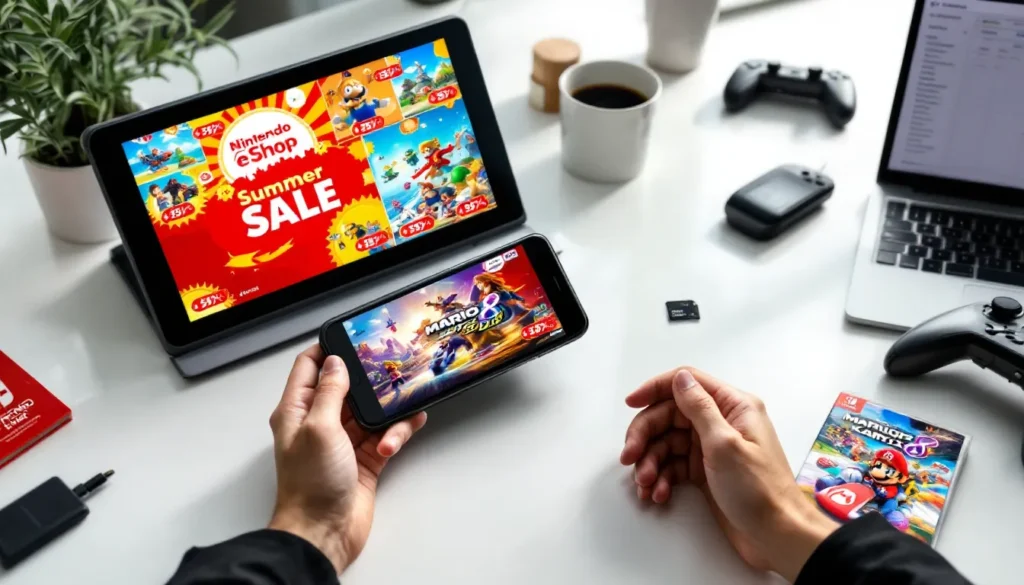
Summer 2026 is heating up, and Nintendo fans know what that means: the annual summer sale is about to drop some of the year’s best discounts on first-party hits, indie darlings, and third-party favorites. Whether you’re hunting for that one Zelda title you’ve been sleeping on or finally ready to jump into the indie backlog, this sale’s got something for everyone.
But timing matters. Miss the window, and you’re back to full price until the next major holiday. With the eShop’s summer promotions typically running for a limited stretch and physical retailers throwing their own counter-offers into the mix, knowing when to buy, what to expect, and how to stack your savings can mean the difference between a decent haul and a legendary one. Here’s the full breakdown on the 2026 Nintendo Summer Sale, dates, predictions, top picks, and pro tips to maximize every dollar.
Key Takeaways
- The Nintendo Summer Sale 2026 is expected to run from late June (around June 22–25) through mid-July (approximately July 12–15), offering roughly two and a half weeks of discounts on games, DLC, and accessories.
- Nintendo Summer Sale discounts typically range from 25–35% for first-party titles like Zelda and Mario, while third-party and indie games often hit 50–70% or deeper, making it the best time to fill your backlog affordably.
- Maximize your savings by stacking Nintendo Gold Points with discounted eShop gift cards (available at retailers for 10% off), setting up wishlists for email alerts, and comparing physical retailer prices against digital eShop pricing.
- Essential games to watch for include The Legend of Zelda: Tears of the Kingdom, Mario Kart 8 Deluxe, and indie favorites like Hades and Hollow Knight, plus hidden gems like Chicory: A Colorful Tale and Slay the Spire that rarely get marketing push.
- Avoid common mistakes like buying before checking your backlog, ignoring all-time-low price history on DekuDeals, and panic-buying on day one—prices remain stable throughout the sale, and additional spotlight discounts appear in week two.
When Does the Nintendo Summer Sale Start and End?
Based on Nintendo’s established patterns, the 2026 Summer Sale is expected to kick off in late June, most likely around June 22–25, and run through mid-July, wrapping up approximately July 12–15. Nintendo typically aligns these promotions with the start of summer vacation windows across North America and Europe, maximizing player engagement when gaming hours spike.
Last year’s sale (Summer 2025) ran from June 23 to July 11, spanning 18 days. The 2024 iteration followed a similar cadence, starting June 20 and ending July 9. If Nintendo sticks to this formula, and they almost always do, expect roughly two and a half weeks of active discounts.
Keep an eye on Nintendo’s official Twitter/X account and the eShop homepage starting mid-June. The company usually teases the sale 24–48 hours before launch, but the exact discount list doesn’t drop until go-time. Set a calendar reminder for June 20 to avoid missing early highlights, especially for limited-quantity physical bundles that sell out fast.
What to Expect from the 2026 Summer Sale
Predicted Discount Ranges for Games and DLC
Nintendo’s first-party titles rarely dip below 30% off, even during major sales. Expect evergreen franchises like The Legend of Zelda, Super Mario, Animal Crossing, and Splatoon to hover in the 25–35% discount range. Occasionally, older releases (games from 2021 or earlier) sneak into the 40–50% zone, but that’s the exception, not the rule.
Third-party AAA titles tend to be more aggressive. Games like Hogwarts Legacy, Assassin’s Creed, and Doom Eternal have historically hit 50–70% off during summer sales. Indie games are the wild card: some go as deep as 75–80% off, especially if they’re older or part of a publisher bundle promotion.
DLC and season passes usually match the base game’s discount percentage, though Nintendo’s own DLC (like the Breath of the Wild Expansion Pass) tends to stay at 20–30% off max. If you’ve been eyeing DLC for Mario Kart 8 Deluxe or Splatoon 3, this is your window.
Hardware and Accessory Deals to Watch For
Don’t expect deep discounts on the Nintendo Switch OLED or base model consoles during the eShop sale itself, Nintendo keeps hardware pricing tight. But, third-party retailers like Amazon, Best Buy, and Target often run $20–$50 bundle offers during the same window, pairing a console with a game or gift card.
Accessories are where the real hardware savings land. Pro Controllers, carrying cases, Joy-Con charging docks, and microSD cards frequently see 20–40% cuts at retailers. If you’re thinking about upgrading storage or grabbing a second controller, wait for retailer announcements around June 20. Many gamers have reported scoring Nintendo Switch OLED bundles with themed accessories at significant savings during past summer promotions.
Top Games Likely to Be Discounted This Summer
Must-Buy First-Party Nintendo Titles
If you’ve been waiting to pull the trigger on Nintendo’s flagship releases, summer 2026 is your shot. Here are the heavy hitters that almost always appear:
- The Legend of Zelda: Tears of the Kingdom – Still commanding top sales three years post-launch, expect 25–30% off at best. If you haven’t played it yet, this is non-negotiable.
- Super Mario Odyssey – A perennial sale favorite, regularly drops to $39.99 (33% off). One of the best 3D platformers ever made.
- Mario Kart 8 Deluxe – The best-selling Switch game. Typically hits $41.99 (30% off). If you somehow don’t own this yet, fix that.
- Splatoon 3 – Multiplayer shooter with ongoing support. Expect 25–30% off, making it around $42–45.
- Animal Crossing: New Horizons – Still wildly popular, usually discounted to $39.99. Great for chill summer sessions.
- Pikmin 4 – Released in 2023, this strategy gem often sees 30% off during major sales.
Nintendo rarely discounts games from the current year heavily, so if a 2026 release is on sale at all, consider it a win.
Best Third-Party and Indie Games on Sale
Third-party publishers go harder during sales, and 2026 should follow suit. Based on past trends and current eShop inventory, watch for:
- Hades – Roguelike masterpiece, frequently hits $12.49 (50% off). If you haven’t played it, this is a must-own.
- Hollow Knight – Metroidvania perfection at $7.49 (50% off). Hundreds of hours of content for under $10.
- Stardew Valley – Farming sim that never gets old, often drops to $10.49 (30% off).
- Celeste – Challenging platformer with heart, expect $9.99 (50% off).
- The Witcher 3: Wild Hunt – Complete Edition regularly hits $19.99 (50% off). Incredible value for 100+ hours of RPG depth.
- Ori and the Will of the Wisps – Gorgeous Metroidvania, typically $14.99 (50% off).
- Cuphead – Run-and-gun boss rush, around $13.99 (30% off).
According to Nintendo Life, indie titles often rotate through “spotlight” promotions during the sale’s second week, pushing discounts even deeper for 48–72 hour windows.
Hidden Gems Worth Picking Up
Beyond the obvious hits, summer sales are perfect for discovering overlooked titles that punch above their weight:
- Chicory: A Colorful Tale – Wholesome painting adventure, often 40% off. Criminally underplayed.
- Tunic – Isometric action-adventure with Zelda vibes, expect 30–40% off.
- A Short Hike – Relaxing exploration game, usually under $5 during sales. Perfect for a lazy afternoon.
- Undertale – If you’ve somehow avoided spoilers, grab it at 20–30% off. Genre-defining RPG.
- Gris – Artistic platformer with no combat, just vibes. Expect 50% off, around $8.49.
- Slay the Spire – Deck-building roguelike that’s easy to lose 100 hours in, often $12.49 (50% off).
These titles rarely get marketing push, but they consistently rank among the highest-rated on the eShop. Summer sales are where they shine.
How to Maximize Your Savings During the Sale
Using Nintendo Switch Online Gold Points
Gold Points are Nintendo’s loyalty currency, and they’re essentially free money if you use them right. Every digital purchase earns you 5% back in Gold Points, and physical game cards earn 1% if you register them within a year of release.
Here’s the play: if you’ve been buying games regularly, you’ve probably stacked up a decent reserve. 100 Gold Points = $1.00 in eShop credit. Check your balance by hitting the profile icon in the top-right corner of the eShop. If you’re sitting on 500+ points, that’s $5+ off your next purchase.
Gold Points expire 12 months after earning them, so use ’em or lose ’em. Summer sales are the perfect time to cash in before older points vanish. Pro tip: buy higher-priced games first to maximize point earnings, then use accumulated points on cheaper indie titles later in the sale.
Stacking Deals with eShop Gift Card Promotions
Retailers like Amazon, Best Buy, Target, and Costco frequently run promotions where you get bonus credit when purchasing eShop gift cards. Common deals include:
- $50 eShop card for $45 (10% instant savings)
- Buy $100, get $10 bonus credit (10% effective discount)
- Costco members: $50 cards often sold in two-packs for $89.99 (10% off)
If you stack a 10% gift card discount with a 30% eShop sale, you’re effectively getting 40% off. That’s how you turn a $60 game into a $36 purchase. Watch Digital Trends for roundups of live gift card deals starting in mid-June, they usually track these closely.
Buy your discounted gift cards before the sale starts so you’re ready to pounce when the deals drop.
Setting Up Wishlists and Price Alerts
The Switch eShop has a built-in Wishlist feature, and it’s clutch for sale hunting. Add any game you’re interested in, and Nintendo will send you an email notification when it goes on sale. No third-party tools needed.
To add a game: open its eShop page, scroll down, and hit the heart icon. That’s it. When the summer sale launches, you’ll get a batch email listing every wishlisted game that’s discounted.
For deeper tracking, use DekuDeals.com. It’s a third-party site (not affiliated with Nintendo) that tracks historical pricing, sends custom alerts, and shows regional price differences. Set your alert threshold, say, “notify me when Metroid Dread hits $35 or lower”, and you’ll get an email the instant it happens. DekuDeals also flags all-time-low prices, so you know if a deal is genuinely good or just okay.
Comparing the eShop Sale to Retail Store Offers
Physical vs. Digital: Which Offers Better Value?
This depends on your priorities. Digital games are convenient, no cartridge swaps, instant access, and they’re tied to your account permanently. But you’re locked into Nintendo’s pricing and can’t resell.
Physical games offer flexibility: you can resell them later (Nintendo titles hold resale value exceptionally well), lend them to friends, or collect them. Retailers like Amazon, Best Buy, and GameStop often undercut eShop prices by $5–$10 on the same titles during summer sales, especially for third-party games.
Example from 2025: The Legend of Zelda: Tears of the Kingdom hit $41.99 on the eShop (30% off) but dropped to $39.99 physical at Target with a RedCard discount stacked. If you’re patient and not anti-physical media, retailer sales can edge out digital.
One major caveat: indie games and smaller titles are almost always digital-only or have limited physical runs at higher prices. For those, eShop is your only real option.
Retailer-Specific Promotions to Consider
Retailers run their own promotions parallel to the eShop sale, and sometimes they’re better. According to GameSpot, major chains typically structure their summer gaming sales around these patterns:
- Amazon: Prime members often get an extra 10–15% off select physical games. Watch for Lightning Deals on accessories.
- Best Buy: Gamers Club Unlocked is dead, but My Best Buy Plus members get early access to sale pricing and occasional bonus trade-in credit.
- Target: RedCard holders (5% off everything) can stack discounts with Circle offers for an effective 10–20% total savings.
- GameStop: Offers trade-in bonuses (extra 20–30% credit) during summer sales. If you’ve got a stack of old games, this is the time to move them.
- Walmart: Typically matches Amazon pricing but without membership requirements. Good backup option.
Physical retailers also bundle games with accessories or gift cards. A “buy two games, get a $10 gift card” deal is effectively $5 off each game, sometimes better than eShop discounts.
Regional Differences in the Nintendo Summer Sale
Nintendo runs separate promotions for North America, Europe, Japan, and Australia, and the deals don’t always align. Regional pricing, currency fluctuations, and local market strategies mean the same game can be significantly cheaper in one region versus another.
North America (US/Canada): Typically gets the broadest selection of discounted titles and deepest cuts on third-party games. The US eShop is often used as the baseline for comparison.
Europe (UK/EU): Sales run simultaneously but sometimes feature different featured games. The UK eShop occasionally has better deals on Japanese imports and niche JRPGs. Euro pricing can look higher due to VAT inclusion, but effective discounts are often comparable.
Japan: Nintendo’s home market sometimes gets exclusive sale items (especially retro/classic titles) but rarely discounts first-party games as aggressively as Western markets. If you have a Japanese account, it’s worth checking, but language barriers apply.
Australia/New Zealand: Often mirrors the US sale structure but with adjusted regional pricing. Historically gets slightly fewer indie titles on deep discount.
Can you exploit regional pricing? Technically, yes, you can create eShop accounts for different regions and buy games where they’re cheapest. But, you’ll need region-specific eShop cards (or a payment method from that region), and you can’t transfer purchases between accounts. Most players find it more hassle than it’s worth unless the savings exceed $15–$20.
Common Mistakes to Avoid When Shopping the Sale
Even veterans slip up during sale frenzies. Here’s what to watch out for:
Buying before checking your backlog. Be honest: do you actually have time to play this right now, or is it going to sit unplayed for six months? Sales create FOMO, but that $15 indie isn’t a deal if you never boot it up.
Ignoring the “all-time-low” price check. A 30% discount sounds great until you realize the game hit 50% off last Black Friday. Use DekuDeals to verify if the current price is genuinely the best it’s been. If not, you might want to wait.
Forgetting to redeem Gold Points first. Always apply your existing points before completing checkout. You can’t add them retroactively, and it’s free money you’re leaving on the table.
Buying the base game when a complete edition is on sale. Sometimes the “Game + DLC” bundle is only $5 more than the base game alone. Check both listings before committing. This happens constantly with games like Borderlands, Breath of the Wild, and Fire Emblem.
Assuming digital is always the best price. Physical copies can be cheaper, especially at retailers running their own competing sales. Do a quick cross-check on Amazon and Best Buy before clicking “Purchase” on the eShop.
Panic-buying on day one. The sale runs for two and a half weeks. Unless you’re eyeing a limited physical bundle, there’s no rush. Prices don’t change mid-sale, and sometimes additional “spotlight” discounts appear in week two.
Overloading on games you’ll never finish. Buying six 100-hour RPGs because they’re cheap is a recipe for burnout and regret. Prioritize quality over quantity. Pick one or two big titles, then fill in with shorter indies.
Past Summer Sale Trends and What They Tell Us
Looking at the last three years of Nintendo Summer Sales reveals consistent patterns that can guide 2026 expectations.
Discount depth has remained stable. First-party Nintendo titles haven’t gotten more generous over time, 30% off is still the ceiling for most flagship releases. Third-party and indie discounts have actually increased slightly, with 50–75% off becoming more common for older titles.
The “featured deals” section rotates. Nintendo highlights specific games on the eShop homepage for 48–72 hours during the sale. These featured titles sometimes get an extra 5–10% shaved off. In 2025, Metroid Dread got bumped from 33% to 40% off during its featured window. If your wishlist game gets spotlighted, that’s your cue to buy.
Week two sees fewer new additions, but surprise drops happen. The bulk of discounted games appear on day one, but Nintendo occasionally adds a second wave of titles midway through. In 2024, several Square Enix RPGs got surprise discounts starting July 3, a week after launch.
DLC rarely goes deeper than the base game. If a game is 30% off, its DLC will be 20–30% off, never more. This has held true across every major sale since 2020.
Physical retail competition has intensified. As eShop sales have become predictable, brick-and-mortar stores have responded with aggressive counter-offers. Summer 2025 saw Best Buy and Target both undercut eShop pricing on several major releases. Don’t skip the physical check.
Games removed from sale don’t return mid-event. If a title isn’t discounted on day one and doesn’t appear in week two’s additions, it’s not happening. Don’t wait hoping a game will magically get added late.
Conclusion
The Nintendo Summer Sale 2026 is shaping up to be another solid opportunity to fill out your library without very costly. With a likely launch window in late June and discounts running through mid-July, there’s plenty of time to strategize, compare prices, and grab the titles you’ve been eyeing.
First-party hits will see their usual 25–35% cuts, third-party games will dive deeper, and indie gems will be everywhere for under $15. Stack your Gold Points, hunt for discounted gift cards, and don’t sleep on physical retailer offers, they’re often better than the eShop for big releases.
Mark your calendar for June 20, set up your wishlist now, and avoid the common pitfalls. Whether you’re hunting for a single must-play or ready to load up on a dozen indies, this sale’s got you covered. Now’s the time to plan your approach so you’re ready to strike when the deals drop.