
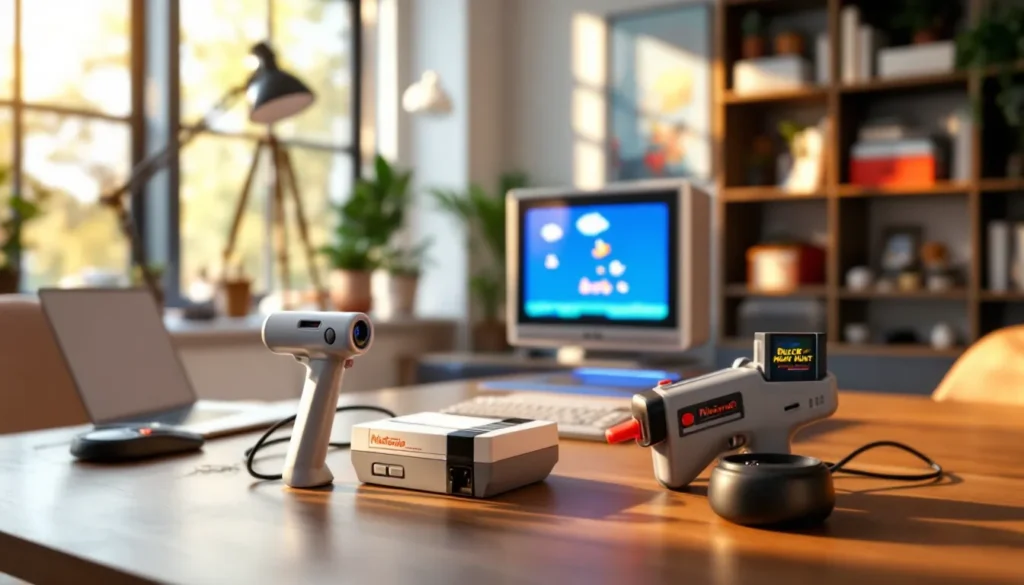
If you grew up in the ’80s or early ’90s, chances are you spent hours aiming that gray plastic Zapper at your TV, squeezing the trigger as pixelated ducks flew across the screen. Duck Hunt wasn’t just a game, it was a phenomenon that introduced millions of players to light gun gaming and became one of the most recognizable titles in Nintendo’s catalog. Whether you remember the thrill of nailing all ten ducks in a round or the frustration of that smug dog laughing at your misses, Duck Hunt left an indelible mark on gaming culture.
This guide dives deep into everything Duck Hunt: from its development and bundled NES release to the science behind the Zapper’s surprisingly clever technology. We’ll break down the gameplay modes, share strategies for dominating higher rounds, explore the cultural legacy that keeps the game relevant decades later, and show you exactly how to play Duck Hunt in 2026, whether you’re hunting for original hardware or leveraging modern options.
Key Takeaways
- Duck Hunt for Nintendo introduced millions to light gun gaming and became a phenomenon bundled with the NES, selling over 28 million copies worldwide and helping revitalize the gaming market after the 1983 crash.
- The NES Zapper uses a clever light detection system that blacks out the screen, draws white target boxes, and reads photodiode sensor input in milliseconds—technology that only works reliably on CRT televisions, not modern flat-screen displays.
- Duck Hunt offers three distinct gameplay modes with progressive difficulty scaling: Game A (single duck), Game B (two simultaneous ducks), and Game C (clay pigeons), each requiring strategic target prioritization and advanced lead-shot techniques for higher rounds.
- The infamous laughing dog became gaming’s first great troll character and enduring cultural icon, transforming failure into an emotionally impactful moment that players remember and discuss nearly 42 years later.
- Playing authentic Duck Hunt Nintendo in 2026 requires original hardware with a CRT television, though Nintendo Switch Online provides an accessible but less immersive alternative using cursor controls instead of the Zapper light gun.
- Duck Hunt’s simple point-and-shoot gameplay with escalating difficulty established a template replicated across modern gaming genres, from mobile games to VR shooting galleries, cementing its legacy as a foundational title in interactive entertainment.
The Origins and Release of Duck Hunt
How Duck Hunt Was Developed
Duck Hunt was created by Nintendo R&D1, the legendary development division led by Gunpei Yokoi, the same team responsible for the Game & Watch series and later the Game Boy. The game was originally released in Japan on April 21, 1984, for the Family Computer (Famicom) as part of Nintendo’s light gun game lineup.
The design was intentionally simple: Nintendo wanted to create an accessible shooting gallery experience that anyone could pick up and play. The development team studied electromechanical arcade shooting games from the ’70s and translated that mechanical satisfaction into a digital format. Duck Hunt’s straightforward premise, shoot ducks, miss too many and you lose, made it perfect for demonstrating the NES Zapper’s capabilities.
The game’s distinctive aesthetic, from the bright blue sky to the dog’s animation frames, was crafted within the NES’s technical limitations. Each duck sprite used only a handful of colors, and the backgrounds were kept minimal to ensure smooth performance and clear target visibility.
The Nintendo Entertainment System Launch Bundle
When Nintendo launched the NES in North America in October 1985, they faced a massive challenge: the video game market had crashed in 1983, and retailers were skeptical about stocking console games. Nintendo’s solution was to position the NES as a toy rather than a video game console, complete with the R.O.B. robot accessory.
Duck Hunt became the killer app for the NES Zapper. Starting in 1985 and through much of the NES’s lifecycle, the system was sold in a bundle that included Super Mario Bros. and Duck Hunt on a single cartridge, along with the Zapper light gun. This bundle became one of the best-selling video game packages of all time, with over 28 million copies sold worldwide.
The dual-game cartridge strategy was brilliant marketing. Super Mario Bros. showcased the NES’s platforming capabilities, while Duck Hunt demonstrated the versatility of the system’s peripherals. For many households, Duck Hunt was the first light gun game they’d ever played at home, making it a gateway to an entirely new genre of interactive entertainment.
How the NES Zapper Light Gun Technology Works
The Science Behind Light Gun Detection
The NES Zapper doesn’t actually shoot anything at your TV, instead, it’s a light detector. When you pull the trigger, a sophisticated timing trick happens in a fraction of a second that most players never noticed.
Here’s the process: When you squeeze the trigger, the NES blacks out the entire screen for one frame. Then, the system draws a white box exactly where each duck is positioned on the screen. The photodiode sensor in the Zapper’s barrel detects whether it’s pointed at a white (lit) area or a black area during this brief moment. If the sensor detects light, the game registers a hit. If it detects darkness, that’s a miss.
This happens so fast, we’re talking about a single frame at 60Hz, or roughly 16 milliseconds, that players perceive it as instantaneous. The black screen flash is visible if you’re paying attention, but in the heat of gameplay, most people never consciously registered it.
The system could handle multiple targets by drawing each duck’s hit box sequentially across multiple frames. In two-duck mode, the game would draw the first duck’s hit box, check the sensor, then draw the second duck’s hit box and check again. This is why there’s technically a tiny processing delay in two-duck mode, though it’s imperceptible during normal play.
Why Duck Hunt Doesn’t Work on Modern TVs
If you’ve tried plugging your old NES into an LCD, LED, or OLED TV and wondered why the Zapper doesn’t work, the culprit is display lag. Modern flat-panel displays process the incoming video signal before showing it on screen, introducing a delay typically between 10-50 milliseconds depending on the TV model and settings.
CRT (cathode ray tube) televisions had effectively zero input lag because they drew the image using an electron beam in real-time. The Zapper was calibrated to detect light at the exact moment the CRT phosphors lit up. Modern displays, but, receive the signal, process it through various image-enhancement circuits, and then display it. By the time the white hit box appears on your LCD screen, the Zapper’s sensor has already taken its reading from a black frame.
Even gaming-oriented TVs with “game mode” settings that reduce processing lag to 5-10ms still don’t work reliably with the Zapper because the detection window is so incredibly narrow. This technological incompatibility is why playing Duck Hunt authentically requires hunting down a CRT television, something that’s become increasingly difficult but not impossible in 2026.
Gameplay Modes and Mechanics Explained
Game A: One Duck Mode
Game A is the classic single-duck mode where one duck at a time flies across the screen. You get three shots per duck, and the challenge increases as you progress through rounds. Starting at Round 1, ducks fly in relatively predictable patterns at moderate speeds.
The key to Game A is patience. With three shots available, you don’t need to panic-fire. Watch the duck’s trajectory for your first shot, and you’ll usually have time to line up a second or third attempt if you miss. Ducks fly in one of several preset patterns: straight diagonal, ascending arc, descending arc, or erratic zigzag.
By Round 10, duck speed increases noticeably, and their movement patterns become more erratic. The game continues increasing difficulty until Round 99, after which the difficulty plateaus. You need to shoot a minimum number of ducks per round to advance, typically 6 out of 10 in early rounds, increasing to 9 out of 10 in later rounds.
Game B: Two Duck Mode
Game B ramps up the challenge by launching two ducks simultaneously. You still get three shots total, but now you need to decide whether to focus on one duck or try for both. Missing both ducks counts as a failed attempt toward your required hit total.
The strategic layer in Game B involves target prioritization. Experienced players quickly identify which duck has the more predictable flight path and eliminate it first, then turn attention to the second target. The gaming culture around Nintendo has celebrated speedrunners who can clear both ducks with just two shots consistently.
Two-duck mode is significantly harder than one-duck mode at equivalent rounds. The same progression system applies, duck speed and minimum hit requirements increase with each round. Many players find Game B more engaging because the split-second decision-making creates more intense gameplay moments.
Game C: Clay Shooting Mode
Game C switches from ducks to clay pigeons, offering a different type of challenge. Instead of flying ducks, clay targets are launched from the bottom of the screen at various angles and speeds. You get two shots per clay, and they typically follow more predictable ballistic arcs than ducks.
Clay shooting emphasizes timing and lead shots. Since clay pigeons follow physics-based trajectories, you can anticipate where they’ll be a split-second after launch. The clays don’t change direction mid-flight like ducks do, making Game C feel more like traditional skeet shooting.
Rounds progress similarly to Games A and B, with clays moving faster and required hit totals increasing. Some players find Game C easier because of the predictable arcs, while others prefer the organic movement patterns of ducks. It’s a nice change of pace and shows Nintendo’s effort to provide variety even though the game’s simple premise.
Scoring System and Round Progression
Scoring in Duck Hunt is straightforward: you earn points based on how quickly you hit each target. Hitting a duck or clay with your first shot awards the most points (typically 1,000 points for ducks in early rounds), while second-shot hits earn less (600 points), and third-shot hits earn the least (300 points).
Bonus points are awarded for hitting all targets in a round, incentivizing perfect rounds. As you advance, the point values increase slightly, but the real challenge comes from the escalating difficulty and minimum hit requirements rather than score chasing.
After every tenth round, you’re treated to a bonus round where the dog retrieves your ducks. This isn’t interactive gameplay, it’s essentially a brief intermission and a psychological reward for progressing. The game tracks your total score across rounds, though Duck Hunt doesn’t have a traditional ending. You play until you fail to meet the minimum duck requirement for a round, at which point you see the Game Over screen and that infamous laughing dog one final time.
Tips and Strategies for Mastering Duck Hunt
Optimal Distance and Positioning
The physical setup for Duck Hunt makes a bigger difference than most players realize. Sitting too close or too far from the screen affects your accuracy and reaction time.
The sweet spot is typically 4-6 feet from a 20-27 inch CRT screen, the standard setup in most ’80s and ’90s living rooms. At this distance, you can see the entire play area without excessive head movement while maintaining precise aim with the Zapper. Sitting closer can help with small targets in later rounds, but you sacrifice peripheral vision and may experience more eye strain.
Angle matters too. Position yourself dead-center to the screen rather than off to one side. The Zapper’s detection cone is most accurate when pointed straight at the screen rather than at an angle. Some players prefer standing, which provides more freedom of movement for tracking fast-moving ducks, though this can be tiring during extended sessions.
Lighting conditions also impact performance. The Zapper works best in moderate lighting, too bright and ambient light can interfere with detection: too dark and you’ll strain to see the targets clearly. Avoid having bright windows or lamps directly behind you, as these can create reflections on the CRT screen.
Advanced Techniques for Higher Rounds
Once you’re consistently reaching Round 10 and beyond, these advanced techniques separate good Duck Hunt players from great ones:
Track before you shoot. Instead of immediately firing when a duck appears, track its movement for half a second. Most ducks follow curved paths rather than straight lines, and that initial tracking moment helps you predict where they’ll be when you pull the trigger.
Lead your shots. In rounds 15+, ducks move fast enough that you need to aim slightly ahead of their current position. The delay between pulling the trigger and the hit detection happening means shooting directly at the duck often results in the detection frame finding the duck slightly past your aim point. Leading by roughly half a duck-length works for most high-speed targets.
Master the patterns. Ducks use a limited set of flight patterns. After dozens of rounds, you’ll start recognizing these patterns in the first few frames of movement. The zigzag pattern, for instance, typically changes direction every second or so. If you learn to anticipate these direction changes, you can position your aim point where the duck will be rather than where it is.
Prioritize smartly in Game B. When two ducks appear, immediately assess which one is closer to escaping off-screen or which has the more erratic pattern. Take out the immediate threat first. Many modern gaming guides analyzing classic Nintendo titles note that this target prioritization mirrors decision-making in contemporary shooters.
Don’t waste shots. In high rounds where you need 9/10 hits, every shot counts. If you’ve already missed a duck twice and its pattern is highly erratic, consider letting it go rather than firing a low-probability third shot. Save your mental energy and focus for the next duck. Missing one duck while maintaining composure is better than tilting and missing three in a row.
The Infamous Laughing Dog and Gaming Culture Impact
No discussion of Duck Hunt is complete without addressing the dog, arguably gaming’s first great troll character. When you miss ducks, the dog pops up from the grass with a distinctly smug expression and a mocking laugh rendered in glorious 8-bit audio. That laugh has echoed through gaming culture for nearly 40 years.
The dog’s taunt was brilliant game design, whether intentional or not. It transformed failure from a neutral event into an emotional one. Missing a duck didn’t just cost you points, it meant enduring that mocking laugh and that dog’s pixelated smirk. For competitive players or those having an off day, the dog’s reaction became genuinely infuriating, creating memorable emotional moments that players discussed for decades.
Nintendo never programmed a way to shoot the dog, even though persistent urban legends claiming otherwise. Players have tried everything: shooting the dog during his jump animation, during the bonus rounds, even attempting to plug a second controller into port 2 to “control” the dog. None of these work in the original game, the dog is invincible and forever judgmental.
The dog became an internet meme long before memes were formally recognized as a cultural category. Early gaming forums in the late ’90s and early 2000s were filled with “I hate the Duck Hunt dog” threads, photoshopped images of the dog in various scenarios, and fan art depicting elaborate revenge fantasies. The character represented something universal: the frustration of failure combined with external mockery.
Interestingly, the dog also appears when you successfully shoot ducks, holding them up proudly. But nobody remembers that version of the dog, it’s the laugh that stuck. That asymmetry in player memory speaks to the psychological impact of negative feedback versus positive reinforcement in game design.
Cultural Legacy and Influence on Modern Gaming
Duck Hunt in Super Smash Bros. Series
Duck Hunt’s most prominent modern appearance is in the Super Smash Bros. series, where the duck and dog appear as a fighter duo starting with Super Smash Bros. for Nintendo 3DS/Wii U (2014) and continuing in Super Smash Bros. Ultimate (2018/2021).
The Duck Hunt fighter is actually a trio: the duck, the dog, and an off-screen gunman (presumably the player). Their moveset cleverly incorporates mechanics from Duck Hunt and other NES Zapper games like Wild Gunman and Hog Wild. The neutral special summons gunmen who shoot opponents, the side special launches explosive clay pigeons, and the down special spawns Wild Gunman characters.
In competitive Smash, Duck Hunt sits in mid-tier for most tier lists. They’re a zoning character with strong projectile game and annoying keep-away tools, though they struggle against rushdown characters who can get inside their optimal range. The character design is a love letter to NES light gun games, and their inclusion in Smash introduced Duck Hunt to an entirely new generation of players who never experienced the original.
Appearances in Other Nintendo Games
Beyond Smash Bros., Duck Hunt references appear throughout Nintendo’s library. In WarioWare games, Duck Hunt frequently appears as a microgame with various twists on the original formula. Wii Play featured a shooting gallery mode clearly inspired by Duck Hunt’s design.
The dog makes cameos in various Nintendo titles, including Animal Crossing series entries where Duck Hunt can appear as a playable NES game in your house. Captain Rainbow on Wii featured the dog as a supporting character. Nintendo clearly recognizes the character’s iconic status and leverages it for nostalgia value.
The game’s influence extends beyond direct appearances. The light gun shooting gallery genre that Duck Hunt popularized led to franchises like Time Crisis, House of the Dead, and countless arcade shooters throughout the ’90s and 2000s. While arcade light gun games existed before Duck Hunt, Nintendo’s home console implementation proved the concept worked for casual audiences and paved the way for PlayStation’s GunCon, Sega’s Stunner, and numerous third-party light gun accessories.
Duck Hunt’s simple but effective game loop, target appears, shoot target, repeat with increasing difficulty, became a template replicated across gaming. You can trace direct lineage from Duck Hunt to mobile games like Angry Birds and even modern VR shooting galleries. The core appeal of point-and-shoot gameplay with progressive difficulty scaling remains fundamentally unchanged since 1984.
How to Play Duck Hunt Today in 2026
Nintendo Switch Online NES Library
The easiest way to experience Duck Hunt in 2026 is through Nintendo Switch Online, where it’s available as part of the NES library. Nintendo added Duck Hunt to the service in April 2023, and it remains accessible to all NSO subscribers.
But, there’s a massive caveat: without the Zapper, the experience is fundamentally different. On Switch, you use the analog stick to move a cursor and press the button to fire. It’s functional, but it completely removes the physical act of aiming and shooting that defined the original experience. You’re essentially playing a cursor-based shooting game rather than a light gun game.
For many players, especially those who never played the original, Switch Online’s version is perfectly adequate. It preserves the gameplay structure, progression, and that infamous laughing dog. But veterans who remember the Zapper experience often find the Switch version feels flat by comparison. It’s Duck Hunt’s skeleton without its soul.
That said, the Switch version includes all three game modes, supports online leaderboards (a modern addition), and offers the convenience of playing anywhere on a handheld device. Nintendo coverage sites regularly feature Duck Hunt in their nostalgia retrospectives, noting how the Switch Online preservation effort keeps these classics accessible even though technological obsolescence.
Original Hardware and CRT Television Setup
For the authentic Duck Hunt experience, you need three components: an original NES console, an NES Zapper, and a CRT television.
As of 2026, this setup is increasingly difficult but still achievable. Working NES consoles sell for $80-150 depending on condition. The Zapper typically costs $15-30 separately. The real challenge is the CRT television. Most people disposed of their CRTs years ago, and finding working units requires checking garage sales, thrift stores, Facebook Marketplace, or retro gaming stores.
When hunting for a CRT, prioritize Sony Trinitron or JVC D-Series models from the late ’90s/early 2000s, these offer excellent picture quality and component input options for other retro consoles. Screen size between 20-27 inches is ideal. Smaller screens make targeting difficult in later rounds: larger screens are heavy and consume significant space.
The original Duck Hunt cartridge is extremely common. Stand-alone versions sell for $5-10, while the Super Mario Bros./Duck Hunt dual cart goes for $10-15. If you’re building a retro setup, this is the cheapest component by far.
Once you’ve assembled the hardware, expect to spend time cleaning the console’s 72-pin connector and cartridge contacts. Most NES issues stem from poor connectivity rather than actual hardware failure. A cleaning kit with isopropyl alcohol and cotton swabs usually solves the infamous blinking screen problem.
Alternative Modern Solutions and Emulation
Several modern alternatives exist for players who want the Zapper experience without full original hardware:
Hyperkin Hyper Blaster HD is a light gun accessory designed for retro gaming on HDTVs. But, reviews are mixed, it works with some displays but not others, and the experience still doesn’t match CRT responsiveness. As of 2026, it’s compatible with original NES through third-party scalers, though setup complexity is high.
Sinden Lightgun is a PC-based solution using camera tracking and a reflective border on your display. It works with emulated Duck Hunt through RetroArch and provides surprisingly authentic light gun gameplay. The Sinden requires a white border around your screen and some calibration, but many enthusiasts consider it the best modern light gun solution for emulated games.
Arcade1Up Duck Hunt Cabinet was released in 2022 and remains available in 2026, though stock varies. This reproduction cabinet includes a CRT monitor and authentic Zapper-style light gun, offering the genuine Duck Hunt experience in a compact form factor. It’s pricey ($300-400) but solves every compatibility issue and includes additional NES Zapper games.
Emulation on PC through RetroArch or MAME allows playing Duck Hunt with mouse controls, similar to the Switch Online version. It’s free and accessible but removes the light gun element entirely. For preservation and casual play, emulation works fine. For the authentic experience, it falls short.
The reality in 2026 is that truly authentic Duck Hunt gameplay requires vintage hardware. Modern solutions offer approximations with varying degrees of success, but nothing quite replicates the immediacy and tactile satisfaction of pointing the Zapper at a CRT and pulling the trigger.
Conclusion
Duck Hunt remains one of Nintendo’s most culturally significant releases, not because of technical sophistication or deep gameplay systems, but because it delivered a specific experience that worked perfectly within its constraints. The combination of accessible shooting gallery gameplay, clever light gun technology, and memorable presentation created something that transcended its simple premise.
Nearly 42 years after its Japanese release, Duck Hunt’s influence persists. Whether you’re playing through Nintendo Switch Online, hunting for original hardware, or simply appreciating the game’s impact on light gun shooters and gaming culture, Duck Hunt represents a specific moment in gaming history when innovation met accessibility.
That laughing dog continues to live rent-free in the minds of millions, a testament to how effective simple emotional design can be. And somewhere, on a CRT television in someone’s basement, a Zapper is still ready to prove that sometimes the oldest games offer experiences that modern technology can’t quite replicate.