
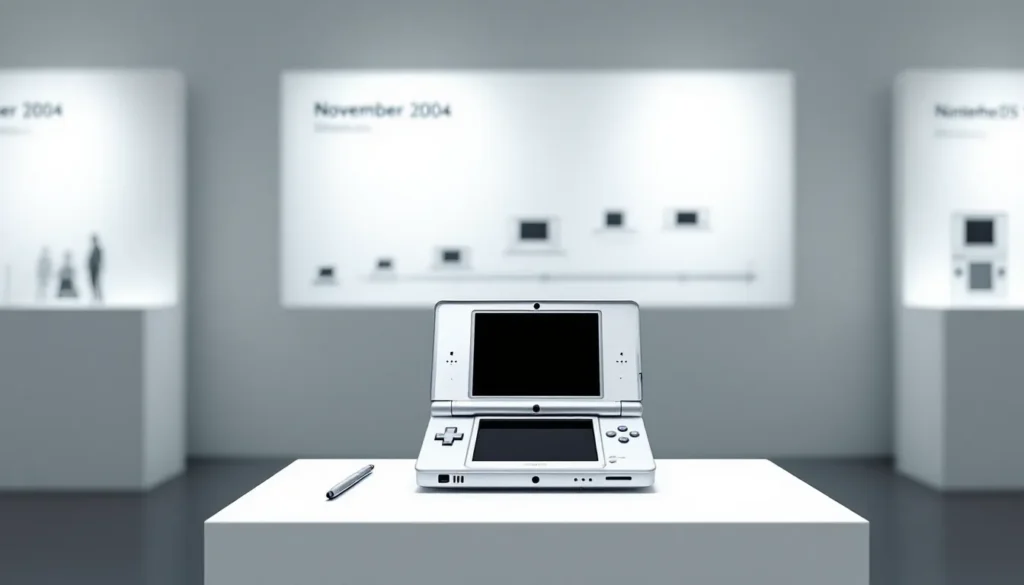
The Nintendo DS didn’t just launch, it rewrote the rulebook for portable gaming. When Nintendo revealed a handheld with two screens and touch input, critics were skeptical. The PSP looked like the obvious winner with its multimedia features and sleek design. But the DS proved that innovation beats specs, becoming the second best-selling video game console of all time with over 154 million units moved worldwide.
If you’re curious about when this transformative device hit shelves, you’re not alone. The DS family spanned nearly a decade, with multiple revisions that refined the formula. Understanding its launch timeline helps explain why it dominated an entire generation of gaming and influenced everything Nintendo has made since.
Key Takeaways
- The Nintendo DS launched on November 21, 2004 in North America at $149.99, followed by Japan (December 2) and Europe (March 2005), revolutionizing handheld gaming with its dual-screen and touch-screen design.
- The DS beat the technically superior PSP by focusing on innovation and unique gameplay experiences rather than raw processing power, becoming the second best-selling video game console of all time with over 154 million units sold.
- Iconic DS launch titles like Super Mario 64 DS and Feel the Magic: XY/XX showcased the console’s revolutionary touch controls, while later games like Nintendogs and Brain Age expanded gaming to casual audiences.
- The Nintendo DS Lite became the definitive model, selling over 93 million units by refining the original design with improved brightness, smaller form factor, and longer battery life.
- The DS’s influence shaped future Nintendo platforms including the 3DS and Switch, proving that innovative design and accessibility matter more than competing on technical specifications.
- Touch-screen gaming mechanics pioneered by the Nintendo DS became the foundation for mobile gaming dominance, from smartphone applications to tablet productivity tools used today.
The Original Nintendo DS Launch: November 2004
Nintendo staggered the DS release across major markets throughout late 2004 and early 2005. The phased rollout gave Nintendo time to build inventory and gauge reception before committing to a full global launch.
North American Release Date
North America got first dibs on the Nintendo DS on November 21, 2004. The system launched at $149.99 USD, undercutting the PSP’s eventual $249.99 price point by a hundred bucks. Nintendo shipped the DS in two color options at launch: silver and black.
The Thanksgiving week timing was strategic. Black Friday 2004 saw massive DS sales, with many retailers selling out within days. Nintendo had prepared approximately 500,000 units for the North American launch, and demand quickly outstripped supply through the holiday season.
Japan Release Date
Japan received the Nintendo DS on December 2, 2004, roughly two weeks after North America. The Japanese launch price was ¥15,000, and the system came in silver only initially. Nintendo prioritized the North American market first, an unusual move for a Japanese company, but one that acknowledged where the strongest early demand would be.
Japanese gamers scooped up 441,485 units in the first three days according to Famitsu sales data. The touch screen mechanics resonated immediately with the Japanese market, where stylus-based interfaces were already familiar from PDAs and earlier Nintendo experiments.
Europe and Australia Release Dates
European gamers had to wait until March 11, 2005 to get their hands on the DS. The system launched at £99 in the UK and €149 in the Eurozone. Australia received the DS on February 24, 2005, priced at AU$199.95.
The delayed European launch gave Nintendo time to prepare software support and build sufficient inventory. By March 2005, the DS library had expanded beyond launch titles, giving European players a more robust game selection from day one compared to North American early adopters.
What Made the Nintendo DS Revolutionary
The DS wasn’t just iterating on the Game Boy formula, it fundamentally reimagined what handheld gaming could be. Three core features separated it from every portable that came before.
Dual Screen Innovation
The dual-screen design was the DS’s defining feature, giving it the “DS” name (officially standing for “Developers’ System” or “Dual Screen” depending on who at Nintendo you asked). The bottom screen measured 3 inches diagonally, while the top screen matched it at 3 inches. Both displayed at 256 × 192 pixel resolution.
Having two screens created new design possibilities. Games could display maps, inventory, or secondary information on one screen while keeping the action uninterrupted on the other. The Legend of Zelda: Phantom Hourglass used the top screen for gameplay while the bottom became a persistent map and puzzle-solving tool. RPGs like Final Fantasy III kept battle action above and commands below.
Touch Screen Technology
The resistive touch screen on the bottom display changed how players interacted with games. Unlike modern capacitive screens, the DS touch screen worked with the included stylus or any pointed object, even fingernails in a pinch. The resistive technology was less precise than today’s capacitive screens but more affordable and durable for 2004.
Touch controls enabled entirely new genres on handhelds. Nintendogs let players pet and interact with virtual dogs naturally. Brain Age turned simple stylus exercises into a phenomenon. The touch screen also made the DS accessible to non-gamers, expanding Nintendo’s audience dramatically. Many industry observers credit this as pioneering work in accessible gaming that influenced the Wii’s motion controls.
Wireless Connectivity and DS Download Play
DS Download Play was quietly revolutionary. The feature let one player with a game cartridge wirelessly share a limited version of that game to up to 15 other DS systems. No additional cartridges needed, just players within wireless range.
This drove multiplayer adoption like nothing before it. A single copy of Mario Kart DS could get an entire room racing together. Metroid Prime Hunters: First Hunt demo units at retail stores used Download Play to spread the experience. The feature created organic marketing, players without the game would try it via Download Play, then often buy their own copy.
The DS also supported standard local wireless multiplayer for players who each owned the game, plus Wi-Fi Connection for online play through Nintendo’s servers (which shut down in 2014). The DS was Nintendo’s first real push into online gaming, though the implementation was primitive by today’s standards, friend codes, anyone?
The Complete Nintendo DS Family Timeline
Nintendo released four distinct DS models between 2004 and 2009, each refining the hardware based on user feedback and manufacturing improvements.
Nintendo DS Lite (2006)
The Nintendo DS Lite launched in Japan on March 2, 2006, followed by North America on June 11, 2006, and Europe on June 23, 2006. Priced identically to the original at launch ($129.99 USD by this point), the Lite addressed every complaint about the original model.
Key improvements included:
- Smaller, sleeker form factor: 33% smaller and 20% lighter than the original
- Brighter screens: Four brightness settings instead of two, with significantly improved visibility
- Better button placement: Relocated microphone and power button for ergonomics
- Longer battery life: 15-19 hours on lowest brightness vs. 10-14 hours on the original
- More color options: Eventually released in over a dozen colors including Crimson/Black, Polar White, and Metallic Rose
The DS Lite became the definitive DS model. It was the version most players owned, moving over 93 million units worldwide, more than any other DS variant.
Nintendo DSi (2008)
Nintendo launched the DSi in Japan on November 1, 2008, with North America and Europe following in April 2009. The DSi retailed for $169.99 USD, marking a price increase over the Lite.
The DSi introduced substantial hardware changes:
- Dual cameras: A VGA camera on the outside (0.3 megapixels) and one facing the user
- DSi Shop: Internal storage and an online shop for downloadable DSiWare games and apps
- Larger screens: 3.25-inch displays, a notable increase from the 3-inch screens
- SD card slot: Expandable storage for photos and downloaded content
- Removed GBA slot: The DSi sacrificed backwards compatibility with Game Boy Advance cartridges
The camera features were gimmicky but fun. Flipnote Studio, a free animation app, became a cult hit on the DSi Shop. The removal of the GBA slot was controversial but allowed for the slimmer profile. Coverage from major gaming outlets at the time noted the trade-off divided the fanbase.
Nintendo DSi XL (2009)
The DSi XL (called DSi LL in Japan) launched November 21, 2009 in Japan and March 28, 2010 in North America at $189.99 USD. This was the largest DS variant, designed for players who wanted bigger screens without sacrificing portability entirely.
The DSi XL featured:
- 4.2-inch screens: 93% larger viewing area than the DS Lite
- Wider viewing angles: Better for sharing games with others nearby
- Larger stylus: More pen-like and comfortable for extended use
- Same internals as DSi: Cameras, DSi Shop, SD card slot, no GBA slot
The XL found its audience among older players and those who played text-heavy games or visual novels. The larger screens made reading easier and reduced eye strain during long sessions. It sold respectably but never matched the Lite’s popularity.
Launch Titles and Early Game Library
The DS launched with a modest but diverse lineup that showcased its unique hardware. North America got six launch titles on November 21, 2004:
- Super Mario 64 DS: A remake of the N64 classic with new characters (Yoshi, Luigi, and Wario), additional stars, and touch screen minigames
- The Urbz: Sims in the City: A Sims spin-off that used the touch screen for character interaction
- Spider-Man 2: A portable version of the movie tie-in game
- Feel the Magic: XY/XX: A WarioWare-style minigame collection designed specifically for touch controls
- Madden NFL 2005: EA’s football sim adapted for dual screens
- Asphalt Urban GT: A racing game that used touch controls for nitro boosts
Super Mario 64 DS was the clear standout, even if controlling Mario with the D-pad and touch screen felt awkward compared to the N64’s analog stick. Feel the Magic best demonstrated what made the DS different, with bizarre touch-screen challenges that had you blowing into the microphone or rubbing the screen frantically.
Japan’s launch lineup was slightly different, leading with Super Mario 64 DS and Sega’s Puyo Pop Fever. Within the first few months, the library expanded rapidly:
- WarioWare: Touched. (December 2004): Perfectly matched the hardware with stylus-based microgames
- The Legend of Zelda: Phantom Hourglass (2007): Eventually became the DS’s killer app for demonstrating touch controls
- Nintendogs (2005): The casual gaming phenomenon that sold DS systems to non-gamers
- Brain Age (2005 JP, 2006 NA): Dr. Kawashima’s brain-training exercises became a cultural sensation
By the end of 2005, the DS had built a library of over 100 games, with strong third-party support from Capcom, Square Enix, Konami, and Ubisoft. The variety was remarkable, everything from hardcore RPGs to cooking sims to guitar instruction software.
How the DS Competed Against the PSP
The DS versus PSP rivalry defined handheld gaming from 2004 to 2011. Sony’s PlayStation Portable launched in Japan on December 12, 2004 and North America on March 24, 2005. On paper, the PSP looked unbeatable.
The PSP offered:
- Superior graphics: PlayStation 2-quality visuals versus the DS’s N64-level capabilities
- Multimedia features: Music, movies, photos, and web browsing
- 4.3-inch widescreen display: Larger than anything on the DS
- Premium build quality: Sleek metal chassis versus the DS’s plastic construction
Sony positioned the PSP as the “Walkman of the 21st Century,” targeting older teens and adults. Publications like IGN praised its technical achievements in early reviews. The gaming press assumed the PSP would dominate based purely on horsepower.
Nintendo took the opposite approach. The DS was cheaper, had longer battery life (up to 19 hours vs. 4-6 hours for PSP), and focused exclusively on unique gameplay experiences. While Sony chased PS2 ports and movie playback, Nintendo experimented with touch controls and asymmetric multiplayer.
The DS won the war decisively:
- Software variety: The DS library was broader, with everything from Final Fantasy RPGs to Cooking Mama to Professor Layton puzzle games
- Regional strength: The DS dominated in Japan and North America: the PSP did better in Europe but still trailed overall
- Piracy concerns: PSP’s openness made it easier to pirate games, hurting software sales and developer confidence
- Casual appeal: The DS attracted non-traditional gamers through Nintendogs, Brain Age, and touch-based interfaces
By 2008, the outcome was clear. Developers committed resources to DS projects while many PSP games underperformed. The PSP sold a respectable 80+ million units worldwide, but the DS nearly doubled that figure. The lesson? Innovation and gameplay trump raw specs in the handheld market.
Sales Success and Market Impact
The Nintendo DS didn’t just succeed, it became a cultural phenomenon that transcended traditional gaming demographics. Its commercial performance remains one of the industry’s greatest success stories.
Total Units Sold Worldwide
Nintendo officially sold 154.02 million Nintendo DS systems worldwide as of September 30, 2014, when the company stopped reporting separate DS figures. This makes the DS family the best-selling handheld console ever made and the second best-selling video game console overall, behind only the PlayStation 2’s 155+ million.
Breakdown by region:
- Americas: 61.57 million units
- Japan: 32.99 million units
- Other regions (Europe, Australia, etc.): 59.46 million units
The DS Lite accounted for roughly 93 million of those sales, making it the most popular variant. The original model moved about 20 million units before the Lite replaced it. The DSi family (DSi and DSi XL combined) contributed approximately 41 million units.
Peak years were 2008-2009, when the DS was selling 30+ million units annually. The system maintained strong sales until the 3DS launch in 2011, then experienced a long tail as Nintendo continued production for emerging markets through 2014.
Best-Selling DS Games of All Time
The DS software library was massive, over 1,800 games released worldwide. The top 10 best-selling titles showcase the platform’s diversity:
- New Super Mario Bros. (2006): 30.80 million copies
- Nintendogs (2005): 24.76 million copies
- Mario Kart DS (2005): 23.60 million copies
- Brain Age: Train Your Brain in Minutes a Day. (2005/2006): 20.22 million copies
- Pokémon Diamond/Pearl (2006/2007): 17.67 million copies
- Brain Age 2: More Training in Minutes a Day. (2005/2007): 15.30 million copies
- Super Mario 64 DS (2004): 11.06 million copies
- Pokémon Black/White (2010/2011): 15.64 million copies
- Pokémon HeartGold/SoulSilver (2009/2010): 12.72 million copies
- Animal Crossing: Wild World (2005/2006): 11.75 million copies
Three of the top six were “casual” games (Nintendogs, Brain Age, Brain Age 2) that attracted non-traditional gamers. This demographic expansion was key to the DS’s unprecedented success. Meanwhile, traditional Nintendo franchises like Mario, Pokémon, and Mario Kart performed as reliably as ever.
Third-party publishers also thrived. Square Enix’s Dragon Quest IX sold 5.5 million copies. Capcom’s Ace Attorney series found its audience on DS. Level-5’s Professor Layton games became a multi-million-selling franchise.
The Legacy of the Nintendo DS in Modern Gaming
The DS’s influence extends far beyond its 2004-2014 lifespan. Its design philosophies and innovations shaped Nintendo’s strategy for the next decade and influenced the broader gaming industry.
Influence on the 3DS and Switch
The Nintendo 3DS, which launched in 2011, was a direct successor that retained the DS’s dual-screen clamshell design while adding glasses-free 3D. The 3DS maintained full backwards compatibility with DS cartridges (except DSi-enhanced features on the base 3DS model), letting players carry their libraries forward.
Key DS elements the 3DS inherited:
- Dual screens with touch on the bottom
- Backwards compatibility preserving the game library
- Focus on unique hardware gimmicks over raw power
- Strong first-party software support with Pokémon, Mario, and Zelda
The 3DS sold 75.94 million units, impressive, but only half the DS’s total. Mobile gaming from smartphones had risen dramatically by 2011, fragmenting the handheld market.
The Nintendo Switch (2017) took a different approach, merging home console and portable gaming into a hybrid device. But the Switch’s design philosophy traces directly to the DS:
- Innovation over specs: The Switch’s hybrid concept mattered more than competing with PS5/Xbox Series X on graphics
- Broad audience appeal: Animal Crossing: New Horizons and Ring Fit Adventure reached casual players the way Nintendogs and Brain Age did on DS
- Portability as core feature: Not an afterthought or separate SKU, but the system’s defining trait
The Switch became Nintendo’s fastest-selling console ever, surpassing 139 million units by early 2024. It proved the DS’s lessons still applied: unique experiences and accessibility trump horsepower.
Touch Screen Gaming Today
The DS normalized touch screen gaming years before smartphones made it ubiquitous. When the iPhone launched in 2007, games like Angry Birds and Fruit Ninja used mechanics DS players already understood, direct manipulation via screen touch.
Modern gaming still shows the DS’s influence:
- Mobile gaming dominance: The DS proved non-traditional interfaces could expand gaming audiences. Smartphones followed that blueprint to billions of players.
- Stylus input on tablets: iPad productivity apps and drawing programs use the same resistive/active stylus concepts the DS pioneered in gaming.
- Nintendo’s continued experimentation: The Switch’s touch screen (in handheld mode) sees limited use, but games like Super Mario Maker 2 include touch-based level editing.
That said, the DS’s resistive touch screen technology is now obsolete. Capacitive screens offer better precision, multi-touch support, and responsiveness. The DS’s legacy isn’t the specific technology, but proving that alternative input methods could define a successful gaming platform.
Conclusion
The Nintendo DS launched November 21, 2004 in North America, kicking off a decade-long run that redefined portable gaming. What seemed like a risky bet, dual screens and a stylus interface, became the blueprint for Nintendo’s most successful handheld ever.
From its staggered 2004-2005 global rollout through four hardware revisions and 154 million units sold, the DS proved that innovation beats specifications. It outlasted the technically superior PSP, attracted players who’d never touched a controller, and built a software library of over 1,800 games spanning every genre imaginable.
The DS’s influence persists in the Switch’s hybrid design, in mobile gaming’s touch-first interfaces, and in Nintendo’s continued commitment to unique gameplay experiences over graphical arms races. For a generation of players, the DS wasn’t just a console, it was the device that defined portable gaming.