
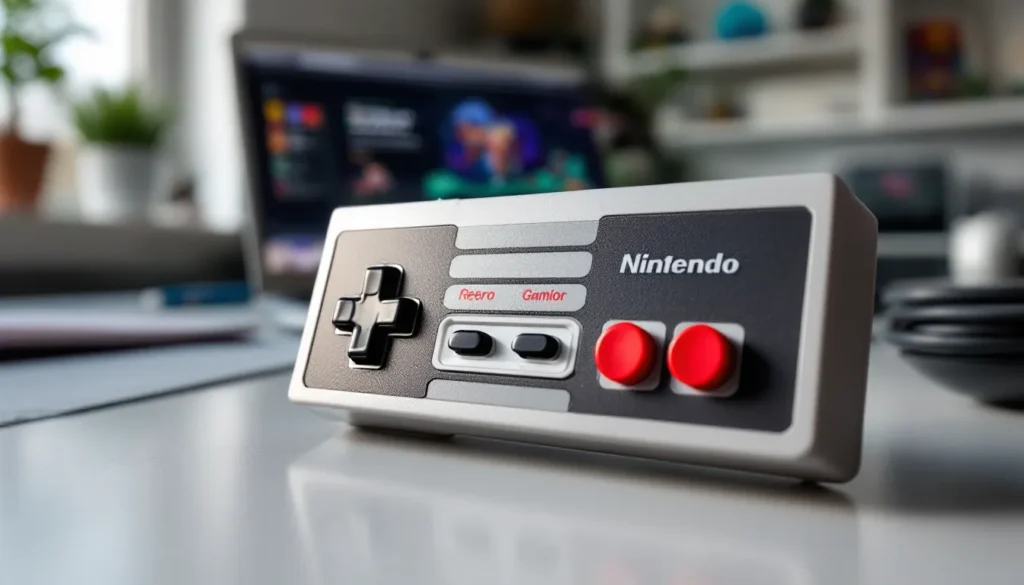
The rectangular piece of plastic with a red and gray color scheme sits in museum exhibits and private collections worldwide, yet its influence echoes through every modern controller you hold today. The Nintendo NES controller didn’t just define how an entire generation played games, it established the blueprint for gaming input that persists four decades later. Released in 1985 alongside the Nintendo Entertainment System, this unassuming gamepad saved the North American video game industry from the brink of collapse and introduced design innovations that competitors still emulate. Whether you’re hunting for an original for your retro collection, troubleshooting a sticky D-pad, or just curious about why this particular controller matters so much, understanding its history reveals why gaming evolved the way it did.
Key Takeaways
- The Nintendo NES controller established the foundational design principles—a cross-shaped D-pad, minimalist button layout, and two-handed input paradigm—that every modern controller from PlayStation to Xbox still follows today.
- Released in 1985 alongside the NES, the controller saved the North American gaming industry from collapse by introducing accessible, intuitive controls that appealed to casual players while enabling precise gameplay for competitive titles like Super Mario Bros.
- Common issues with vintage NES controllers like sticky buttons and D-pad problems are repairable through simple maintenance: replacing conductive pads, cleaning PCB contacts with isopropyl alcohol, and realigning pivot points.
- Original NES-004 controllers typically cost $20–35 in working condition, while modern reproductions from 8BitDo and Retro-Bit offer wireless convenience and affordability ($15–45) but with slightly less responsive D-pads than authentic hardware.
- The NES controller’s cultural significance transcends gaming, appearing as a symbol of retro nostalgia on merchandise and representing an era of user-serviceable, durable electronics designed for simplicity over feature bloat.
- Rare variants like Championship gold controllers and sealed new old stock examples can command $500–1,500, but authentication is critical since counterfeits are widespread; standard controllers remain common and appreciate slowly at 2–4% annually.
The Birth of an Icon: How the NES Controller Changed Gaming Forever
When Nintendo released the Famicom in Japan in 1983, the controllers were hardwired to the console and featured a distinct red-and-gold aesthetic. But when engineer Masayuki Uemura and designer Gunpei Yokoi prepared the system for the North American market two years later, they made critical changes that would define the controller’s legacy.
The NES controller emerged during what’s now called the video game crash of 1983, a period when oversaturated markets, poor-quality games, and loss of consumer confidence nearly killed home gaming entirely. Nintendo pitched the NES not as a game console but as an “entertainment system,” complete with a robot accessory (R.O.B.) and a redesigned controller that looked sophisticated rather than toy-like.
The gamepad’s rectangular form factor measured approximately 4.8 inches wide by 2.1 inches tall by 0.7 inches deep, featuring a 6-foot cable that connected via a proprietary 7-pin connector. That cable length gave players freedom to sit comfortably away from the television, a small detail that improved the gaming experience significantly compared to competitors with shorter cords.
What truly set the NES controller apart was its minimalist philosophy. While competitors packed controllers with numeric keypads and excessive buttons, Nintendo stripped gaming input down to essentials: a directional pad, two action buttons (A and B), and Start and Select buttons. This simplicity lowered the barrier to entry for non-gamers and allowed developers to create intuitive control schemes that anyone could grasp within minutes.
Design and Technical Specifications of the Original NES Controller
The original NES-004 controller housed surprisingly straightforward electronics within its ABS plastic shell. Inside, conductive rubber pads made contact with carbon traces on the PCB when buttons were pressed, completing circuits that sent signals to the console’s CPU. This contact-based design was both cost-effective and reliable, though it would eventually lead to the wear issues vintage controllers face today.
The button configuration featured A and B action buttons arranged horizontally on the right side, with Start and Select centered below the middle. This layout forced players to use one hand for movement and another for actions, a paradigm that became standard across the industry. The buttons themselves provided tactile feedback with a satisfying click, using simple dome switches that were easy to manufacture but prone to degradation over decades.
The Revolutionary D-Pad: A Game-Changer in Controller Design
Gunpei Yokoi’s cross-shaped directional pad represents perhaps the most significant innovation in controller history. Before the D-pad, most controllers used joysticks or individual directional buttons, which lacked precision and felt awkward for platformers and action games.
The D-pad solved this through elegant engineering: a single piece of molded plastic sat atop four separate switches arranged in a cross pattern. When players pressed any direction, the plastic piece pivoted on a central point, activating the corresponding switch while maintaining tactile feedback for diagonal inputs through simultaneous activation of adjacent switches.
This design allowed for eight-directional movement (up, down, left, right, and four diagonals) with unprecedented accuracy. Games like Super Mario Bros. and Mega Man demanded frame-perfect jumps and precise platforming that would’ve been nearly impossible with earlier joystick designs. The D-pad’s responsiveness gave players the control necessary to execute these moves consistently.
Nintendo held patents on the cross-shaped D-pad design, forcing competitors to develop alternatives like Sega’s circular pad on the Master System controller. Many gaming enthusiasts and technology reviewers at PCMag still consider Nintendo’s original implementation superior to most modern D-pad variations.
Button Layout and Ergonomics: Simple Yet Effective
The NES controller’s ergonomics seem primitive by modern standards, but its rectangular brick shape served a purpose. The flat design meant the controller could rest comfortably on laps or be gripped in two hands without strain during extended gaming sessions.
The A and B button placement established what would become Nintendo’s signature layout philosophy, the primary action button (B) positioned to the left of the secondary button (A). This seemed counterintuitive to Western players accustomed to left-to-right reading patterns, but it placed the jump button (typically B in platformers) directly under the player’s thumb in a natural resting position.
The Start and Select buttons used smaller, recessed switches that prevented accidental presses during gameplay. Start typically paused games or confirmed menu selections, while Select cycled through options or switched between single and multiplayer modes. Their central placement meant players could easily reach them with either thumb without repositioning their grip.
The controller weighed approximately 2.6 ounces without the cable, light enough to avoid hand fatigue but substantial enough to feel quality rather than cheap. The textured grip on the back side prevented slipping, though the smooth front surface sometimes became problematic during intense gaming sessions with sweaty hands.
How the NES Controller Influenced Modern Gaming Controllers
Walk into any gaming setup in 2026 and you’ll see the NES controller’s DNA in every gamepad. The innovations Nintendo introduced in 1985 didn’t just influence competitors, they established the fundamental language of gaming input that persists across PlayStation, Xbox, and even mobile gaming interfaces.
From D-Pads to Button Layouts: Legacy in Today’s Controllers
Every modern controller from the DualSense to the **Xbox Series X
|
S controller** features a D-pad descended directly from the NES design. While manufacturers have added analog sticks, triggers, and haptic feedback, the D-pad remains essential for fighting games, retro titles, and precise menu navigation.
The fighting game community especially appreciates quality D-pads, with professional players on competitive gaming platforms like ProSettings often preferring controllers with superior directional input for execution-heavy games like Street Fighter or Tekken. Nintendo’s original cross design is still considered the gold standard for 2D movement.
The face button philosophy, using a primary cluster of action buttons on the right side with system buttons in the center, became universal. Sony’s triangle-circle-X-square, Microsoft’s A-B-X-Y, and Nintendo’s own continued A-B layouts all trace back to that original NES-004 configuration. Even the shoulder buttons introduced on the SNES evolved from the design principle of keeping core actions accessible without hand repositioning.
The two-handed grip paradigm established by the NES controller shaped every subsequent gamepad. While the NES controller was too small and flat to be truly ergonomic, it proved that players instinctively understood splitting directional input (left hand) from action input (right hand). Later controllers simply added curves, grips, and analog sticks to this proven foundation.
Nintendo’s Continued Use of NES Design Elements
Nintendo has consistently honored the NES controller’s legacy through decades of hardware iterations. The Super Nintendo controller maintained the D-pad and basic layout while adding shoulder buttons. The Nintendo 64 introduced analog sticks but kept the D-pad as a backup option. Even the revolutionary Wii Remote could be turned sideways to mimic the NES controller’s button arrangement for Virtual Console games.
The Nintendo Switch Joy-Con controllers feature individual buttons instead of a D-pad on the left Joy-Con specifically to allow each controller to function independently, but when players want precision, they typically opt for the Nintendo Switch Pro Controller, which includes a traditional cross-shaped D-pad that’s virtually identical to the NES original in function if not form.
Nintendo’s commitment to this design philosophy extends to its retro offerings. The NES Classic Edition (released in 2016) and the NES controllers for Nintendo Switch (available through Nintendo Switch Online membership) are nearly identical reproductions of the original NES-004, updated only with modern connection technology. These faithful recreations acknowledge that the original design achieved something remarkable, a controller so intuitive and effective that it requires no meaningful improvement for the games it was designed to play.
NES Controller Variants and Special Editions Throughout the Years
The standard NES-004 controller wasn’t the only gamepad Nintendo produced for the system. Throughout the NES’s lifespan and in subsequent decades, several official variants emerged, each with distinct characteristics that collectors and players should know.
The Dogbone Controller: NES-101 Redesign
When Nintendo released the top-loading NES-101 (also called the “New-Style NES” or “NES 2”) in 1993, they included a dramatically redesigned controller that gamers nicknamed the “Dogbone” due to its curved, bone-like shape. The official model number was NES-039.
This redesign addressed many ergonomic complaints about the original rectangular controller. The Dogbone featured:
- Rounded grips that fit more comfortably in hands of various sizes
- Recessed directional pad and buttons that reduced accidental inputs
- Slightly different button feel with less tactile click but smoother response
- Shorter cable at approximately 5.5 feet, slightly less than the original
- Color-coded A and B buttons (red B, maroon A) instead of uniform purple
The Dogbone controller is compatible with original front-loading NES consoles and is actually preferred by many players for extended gaming sessions. But, purists argue that the original rectangular design offers better D-pad precision for games requiring perfect diagonal inputs.
Interestingly, the Dogbone design influenced the Nintendo Switch GameCube controller ergonomics that would emerge years later, showing Nintendo’s continued evolution of comfortable grip design.
Wireless and Modern Recreations for Switch and Collectors
The retro gaming boom of the 2010s brought numerous NES controller recreations:
Official Nintendo Products:
- NES Classic Edition controllers (2016): Bundled with the miniature console, these feature authentic NES-004 dimensions with a Wii Remote-style connector
- NES Controllers for Nintendo Switch (2018-present): Wireless Bluetooth controllers exclusively for Nintendo Switch Online subscribers, featuring motion controls and rechargeable batteries while maintaining original aesthetics
- NES Controller wireless via 8BitDo adapters: Third-party solutions that add wireless functionality to original controllers
Third-Party Recreations:
- 8BitDo N30/NES30 controllers: Bluetooth-enabled replicas with additional features like analog sticks and modern button configurations
- Retro-Bit NES controllers: Licensed reproductions with turbo functionality
- Hyperkin “Cadet” controllers: Premium builds with improved cable durability
The official Nintendo Switch NES controllers deserve special mention because they’re functionally identical to the original NES-004 in layout and feel, but they connect wirelessly via Bluetooth, charge via USB-C, and include rechargeable batteries. They work exclusively with NES games on Nintendo Switch Online, maintaining the authentic experience for titles like Super Mario Bros. 3 and The Legend of Zelda.
As Nintendo enthusiasts on Nintendo Life frequently discuss, these modern recreations walk a fine line between authenticity and convenience, with purists preferring original hardware and casual retro gamers appreciating the wireless convenience.
Common Issues and How to Repair Your NES Controller
Vintage NES controllers, now 35-40 years old, commonly exhibit specific failure patterns related to material degradation and wear. The good news is that most issues are repairable with basic tools and patience.
Troubleshooting Unresponsive Buttons and D-Pad Problems
The most common complaint with aging NES controllers is unresponsive or sticky buttons, particularly the A and B buttons that see the heaviest use. This typically results from:
Worn conductive pads: The rubber membranes inside buttons have a conductive carbon coating that degrades over time. When the coating wears away, button presses don’t register consistently.
Fix: Replace the conductive pads entirely or use conductive paint to restore the carbon coating. Replacement pad kits are available from retro gaming suppliers for $5-10 and include pads for all buttons.
Dirty PCB contacts: Dust, skin oils, and residue accumulate on the carbon traces where conductive pads make contact.
Fix: Clean the PCB contact points with isopropyl alcohol (90% or higher concentration) and a cotton swab. Let it dry completely before reassembly.
D-pad directional issues manifest as inputs not registering in specific directions or unwanted diagonal inputs. This usually stems from:
Misaligned D-pad pivot: The central pivot point can shift if the controller has been dropped or the plastic has warped.
Fix: Carefully realign the D-pad during reassembly, ensuring the central contact point sits perfectly centered over the four directional switches.
Worn directional switches: The individual switches under the D-pad can fail after millions of presses.
Fix: Desolder and replace individual tactile switches (6mm x 6mm switches are standard) or swap in a donor PCB from a broken controller.
Cleaning and Maintenance Tips for Vintage Controllers
Proper maintenance can extend an NES controller’s life indefinitely:
Exterior cleaning:
- Mix mild dish soap with warm water
- Use a soft cloth dampened (not soaked) with the solution to wipe down the plastic shell
- Use a toothbrush for textured areas and crevices
- Dry thoroughly with a microfiber cloth
- For yellowed plastic, retrobrite solutions can restore original gray color (though this is controversial among collectors)
Interior cleaning:
- Open the controller using a 3.8mm gamebit screwdriver (security bit required for NES hardware)
- Remove the PCB and rubber membranes
- Wipe the PCB with isopropyl alcohol, avoiding excessive moisture
- Clean rubber membranes with mild soap and water, ensuring they’re completely dry before reassembly
- Inspect the cable where it enters the controller for fraying, this is a common failure point
Cable repair:
Frayed or broken cables can be repaired by cutting away damaged sections and resoldering wires to the PCB. Each of the seven wires has a specific function:
- White: Ground
- Red: +5V power
- Orange: Data output
- Yellow, brown, light blue, green: Additional data/ground lines (function varies by revision)
Document wire positions before desoldering, as incorrect reconnection will cause the controller to malfunction.
Storage best practices:
- Store controllers in cool, dry environments away from direct sunlight
- Avoid wrapping cables tightly around controllers, which stresses wires at connection points
- Use protective cases or bags to prevent dust accumulation
- Test controllers periodically to catch developing issues early
For controllers with sentimental value or rare variants, consider keeping them as display pieces and using reproduction controllers for actual gameplay. The mechanical stress of regular use inevitably degrades components, and some parts are increasingly difficult to source as the retro gaming community depletes available donor hardware.
Where to Buy NES Controllers in 2026: Original vs. Reproduction
The market for NES controllers in 2026 divides sharply between authentic vintage hardware and modern reproductions, each with distinct advantages depending on your use case.
Authentic Original Controllers: What to Look For
Genuine NES-004 and NES-039 controllers remain readily available through multiple channels:
Online marketplaces:
- eBay: Widest selection with prices ranging from $15 for untested “as-is” controllers to $50+ for verified working units with minimal wear
- Facebook Marketplace and Craigslist: Local deals often include controllers bundled with consoles, typically $10-25 per controller
- Retro game stores: Tested and guaranteed working controllers usually run $25-40
- Yard sales and estate sales: Best prices ($5-15) but require patience and luck
Authentication and quality checks:
When buying original controllers, verify these details to ensure you’re getting genuine Nintendo hardware:
- Embossed Nintendo seal: Authentic controllers have “Nintendo” embossed on the back, not just printed
- Screw type: Original NES controllers use 3.8mm gamebit security screws, not Phillips heads
- Cable thickness: Genuine cables are relatively thick with substantial insulation
- Weight and plastic quality: Reproductions often feel lighter and use cheaper plastic
- Button feel: Original buttons have a distinct click: reproductions often feel mushy
Red flags for counterfeits or heavy wear:
- Extremely yellowed plastic (normal aging) vs. uniform discoloration (chemical exposure)
- Cracked plastic around screw posts (common stress point)
- Modified or replaced cables (not necessarily bad, but affects value)
- Missing or incorrect screws (indicates previous repair attempts)
Price expectations for 2026:
- Working NES-004 (standard rectangular): $20-35
- Working NES-039 (Dogbone): $25-45 (slightly rarer)
- Mint/new old stock condition: $75-150
- Controllers with cosmetic damage but functional: $10-20
Best Third-Party and Reproduction Options
Modern reproduction controllers offer advantages over vintage hardware for regular gameplay:
Top third-party manufacturers:
8BitDo produces premium Bluetooth-enabled controllers that balance authenticity with modern features:
- N30 2.4G Wireless: $25, works with original NES hardware via 2.4GHz dongle
- N30 Pro 2: $45, adds analog sticks and works across multiple platforms
- Excellent build quality with responsive D-pads that closely match original feel
Retro-Bit offers officially licensed Nintendo controllers:
- Retro-Bit NES Controller: $15-20, wired replicas with turbo function
- Legacy16 USB Controller: $20, works with PC and compatible with emulators
- Solid budget option though D-pad feels slightly less precise than originals
Hyperkin focuses on durability improvements:
- “Cadet” Premium Controller: $25, reinforced cable and improved conductive pads
- Extended 10-foot cable for modern TV setups
- Slightly heavier than originals but more resistant to wear
My Arcade produces budget reproductions:
- NES Controller: $10-12, basic functionality
- Acceptable for casual play but inferior build quality
- D-pad tends to feel mushy compared to authentic controllers
Performance comparison:
For competitive retro gaming or speedrunning, the D-pad response time and precision matter significantly. Original Nintendo controllers generally outperform third-party options in:
- Input lag (original controllers have essentially zero lag: some wireless reproductions introduce 1-3ms)
- Diagonal precision (crucial for games like Contra or Ninja Gaiden)
- Button tactility (important for timing-dependent games)
For casual retro gaming or collection display, quality reproductions from 8BitDo or Retro-Bit offer excellent value with added convenience features like wireless connectivity and compatibility with modern devices.
Where to buy reproductions:
- Amazon: Widest selection of third-party controllers with customer reviews
- Manufacturer websites: Direct purchase often includes warranties
- Retro gaming specialty retailers: Stone Age Gamer, Retro Game Store, and similar outlets
- Nintendo Store (official recreations only): NES Controllers for Nintendo Switch available exclusively to Switch Online members
Collecting NES Controllers: Rare Finds and Value Guide
While standard NES controllers are common, certain variants and special editions command significant premiums in the collector market. Understanding what makes specific controllers valuable helps collectors make informed purchases and avoid overpaying for common items misrepresented as rare.
Genuinely rare and valuable controllers:
Gold Championship Cartridge Controllers (estimated 100-200 exist): Nintendo Power held competitions in 1990 where winners received gold-painted controllers. Authenticated examples sell for $500-1,500 depending on condition. But, be extremely cautious, gold spray paint is cheap, and fakes vastly outnumber legitimate examples. Provenance documentation is essential.
Early Famicom Controllers (Japanese market, 1983-1985): The original red-and-gold Famicom controllers with hardwired cables are historically significant. Complete Famicom systems with both controllers in excellent condition range from $150-300. Player 2 controllers included a built-in microphone, a unique feature absent from NES versions.
New Old Stock (NOS) sealed controllers: Factory-sealed NES-004 controllers in original Nintendo packaging are exceptionally rare as controllers were typically bundled with consoles. Authenticated sealed examples command $200-400, though the market is small since serious collectors prefer to verify functionality.
Regional variants: PAL region controllers (Europe/Australia) with slightly different plastic molding and cable specifications appeal to completionist collectors but rarely exceed $50-75 even in excellent condition.
Moderately collectible variants:
Dogbone controllers (NES-039): Due to the limited production run of the top-loading NES, Dogbone controllers are somewhat scarcer than standard rectangular controllers. Premium over standard controllers: approximately $10-15 in comparable condition.
Licensed third-party controllers from the NES era: Controllers from manufacturers like Acclaim, Konami, and Camerica that were officially licensed during the NES’s active lifespan have nostalgic appeal. Values typically range $15-40 depending on brand recognition and unique features (turbo buttons, programmability).
Condition grading and value impact:
Controller condition dramatically affects value:
- Mint/NOS (10/10): No wear, original packaging, never used – 400-500% premium
- Excellent (9/10): Minimal wear, all original parts, no yellowing – 100-150% premium
- Very Good (8/10): Light use, minor yellowing, fully functional – 25-50% premium
- Good (7/10): Noticeable wear, some yellowing, fully functional – baseline market price
- Fair (6/10): Heavy wear, functional with issues – 50% of market price
- Poor (5/10 or below): Parts/repair only – $5-10
What doesn’t add value:
Contrary to some listings on marketplace sites, these factors don’t meaningfully increase controller value:
- Custom paint jobs or modifications (usually decrease value)
- Cleaning or restoration (expected, not premium-worthy)
- Replacement cables (necessary repair, not upgrade)
- Bundling with common games
Investment perspective for 2026:
NES controller values have remained relatively stable over the past decade, with slow appreciation of 2-4% annually for common variants. This makes them poor financial investments but reasonable collectibles for gaming enthusiasts. The market is well-supplied since Nintendo sold over 60 million NES consoles worldwide, each bundled with at least one controller.
Rare variants show better appreciation potential, but authentication challenges and small market size make them risky investments. For most collectors, the recommendation is to buy controllers you’ll actually use or display rather than banking on significant value appreciation.
Where serious collectors find rare controllers:
- Heritage Auctions and similar houses: Authenticated rare variants occasionally appear
- Retro gaming conventions: Vendors sometimes have unusual variants
- Japan import specialists: For Famicom controllers and regional exclusives
- Estate sales and storage auctions: Occasionally yield sealed or mint condition hardware
The collecting community generally advises against paying premiums for controllers without verified provenance, especially for supposedly “rare” variants that could easily be reproduced or faked.
Why the NES Controller Remains a Gaming Culture Icon
Forty years after its introduction, the NES controller transcends its function as a gaming peripheral to occupy a unique position in popular culture. Its rectangular silhouette appears on t-shirts, tattoos, wall art, and jewelry worn by people who may have never touched an actual NES.
This cultural staying power stems from the controller’s role during a formative period for millions of gamers. The NES dominated the late 1980s and early 1990s, a pre-internet era when gaming was a primarily local, social activity. Players passed controllers between friends during multiplayer sessions, creating shared memories tied to the physical object itself. That tactile connection, the feel of the plastic, the click of the buttons, the weight of the cable, anchored gaming experiences in ways that modern wireless controllers don’t replicate.
The aesthetic simplicity also contributes to the controller’s iconic status. Unlike complex modern gamepads bristling with triggers, sticks, and touchpads, the NES controller communicates its purpose instantly. Two buttons, a D-pad, Start, Select, anyone can understand it at a glance. This visual clarity makes it perfect as a cultural symbol representing “gaming” in the broadest sense.
Game developers continue to reference the NES controller in their work. Indie titles like Shovel Knight and Celeste deliberately design control schemes around NES-era limitations, creating gameplay that feels authentic to that era. These games succeed partly because the NES controller’s simplicity forced creative game design that emphasized precision, timing, and level design over complex button combinations.
The speedrunning and competitive retro gaming communities have kept the NES controller relevant in practical terms. Runners competing in Super Mario Bros. or The Legend of Zelda categories require controllers with frame-perfect precision, and many prefer original Nintendo hardware over reproductions. This competitive use validates the controller’s functional excellence rather than just its nostalgia value.
Nintendo itself recognizes the controller’s iconic status, consistently releasing new iterations for modern platforms. The decision to make nearly identical reproductions for the Switch acknowledges that the original design achieved something timeless, improving it would mean making it different, not better.
In broader gaming culture, the NES controller serves as a touchstone for discussions about game design philosophy. Modern games often struggle with control complexity, tutorializing dozens of buttons and combinations. The NES era proved that deep, engaging gameplay could emerge from minimal input options, a lesson that resonates with developers creating mobile games, accessibility-focused titles, and retro-inspired indies.
The controller’s cultural impact extends beyond gaming into general tech nostalgia. It represents an era when electronics were user-serviceable, built to last, and designed with straightforward functionality over feature bloat. In an age of planned obsolescence and sealed devices, the NES controller’s repairability and longevity appeal to people frustrated with modern consumer electronics.
Conclusion
The NES controller succeeded because it solved the right problems at the right time. Gunpei Yokoi’s D-pad gave players precision that joysticks couldn’t match. The minimal button layout made games accessible without sacrificing depth. The simple, durable construction meant controllers survived years of intense use by kids who weren’t gentle with their hardware.
That original 1985 design still holds up today, not just as nostalgia, but as functional, effective input for the games it was built to play. Whether you’re repairing a vintage controller for your collection, buying a reproduction for retro gaming sessions, or just appreciating the design philosophy behind it, the NES controller represents the moment when gaming figured out its fundamental language. Every controller since has been iterating on the vocabulary Nintendo established with that gray and red rectangle.