
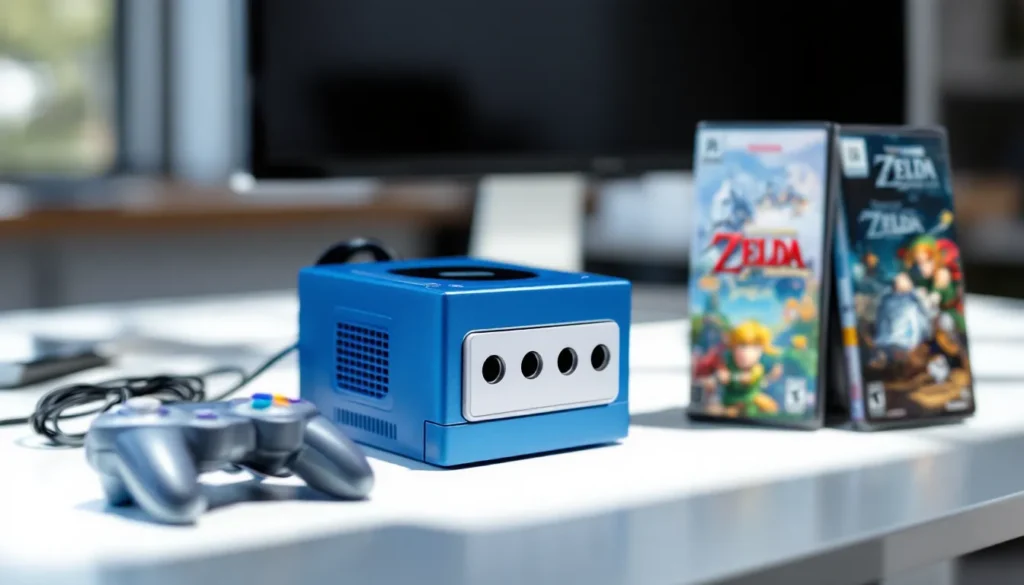
The Nintendo GameCube landed in 2001 with a handle on top, a lunchbox design, and mini discs that made purists scratch their heads. It sold 21.74 million units worldwide, getting stomped by the PlayStation 2’s 155 million and even trailing the original Xbox’s 24 million. By those numbers, it was a commercial failure. But here’s the thing: the GameCube punched way above its weight in ways that mattered more than sales charts.
This little purple cube (and later, black and platinum variants) introduced analog triggers to Nintendo controllers, delivered some of the tightest first-party games ever made, and proved that horsepower isn’t everything when you’ve got art direction and gameplay dialed in. Two decades later, GameCube controller adapters sell out for Smash Bros. tournaments, original copies of games like Fire Emblem: Path of Radiance fetch hundreds of dollars, and emulation communities keep the library alive for new generations.
Whether you grew up with it or you’re curious why veteran gamers won’t shut up about it, the GameCube deserves a closer look. Let’s break down what made it special, why it stumbled in the marketplace, and how you can experience it today.
Key Takeaways
- The Nintendo GameCube sold 21.74 million units and finished third behind the PS2 and Xbox, but delivered exceptional first-party games and controller innovations that influenced gaming for decades.
- The GameCube’s analog triggers, ergonomic design, and asymmetric button layout revolutionized controller design, with the original controller still preferred by competitive Smash Bros. players in 2026.
- Exclusive GameCube titles like Fire Emblem: Path of Radiance, Metroid Prime, and The Legend of Zelda: The Wind Waker remain highly valuable collector’s items, with prices skyrocketing due to rarity and limited re-releases.
- Modern players can experience GameCube games through original hardware ($60–$200), Dolphin emulation with HD upscaling, or HDMI adapters like the Carby ($75) and EON GCHD ($149) for cleaner digital output on modern TVs.
- The GameCube’s philosophy of prioritizing gameplay over raw specs and multimedia features influenced Nintendo’s Wii and Switch designs, proving that innovation in user experience trumps processing power.
The Birth of the GameCube: Nintendo’s Bold Risk in the Console Wars
Nintendo entered the sixth console generation with something to prove. The N64 had struggled against the PlayStation’s CD-based dominance, and Sega was bleeding out with the Dreamcast. Sony’s PS2 was already on shelves in Japan by March 2000, doubling as a DVD player and securing early market control. Microsoft, a total newcomer, was about to drop the Xbox with PC-grade hardware and an integrated hard drive.
Nintendo’s answer? A compact, affordable console with a focus on gameplay over multimedia features. The GameCube launched in Japan on September 14, 2001, hitting North America on November 18 at $199, a full $100 cheaper than the Xbox. That price point was strategic: Nintendo wanted to compete on value and game quality, not raw specs or media functionality.
The console’s codename during development was “Dolphin,” and remnants of that branding stuck around in the system files and SDK documentation. Nintendo tapped IBM for a custom 485 MHz PowerPC processor (codenamed Gekko) and partnered with ArtX (later acquired by ATI) for the GPU, dubbed “Flipper.” The result was a machine that could push more polygons per second than the PS2, with better texture compression and lighting effects.
But Nintendo made one controversial call that would haunt the GameCube’s third-party support: proprietary mini discs.
Technical Specifications That Set It Apart
Here’s what the GameCube packed under that handle:
- CPU: IBM PowerPC Gekko at 485 MHz
- GPU: ATI Flipper at 162 MHz
- RAM: 24 MB main RAM (1T-SRAM), 16 MB ARAM for audio
- Storage: 1.5 GB GameCube Game Discs (mini DVD format)
- Video Output: Up to 480p via component cables (few games supported it, but Metroid Prime and Resident Evil 4 looked stunning)
- Controller Ports: Four built-in, no multitap needed
- Memory Card Slots: Two proprietary slots for saves
The specs weren’t bleeding-edge, but they were efficient. The GameCube had lower latency than the PS2, which meant tighter controls and faster load times in optimized titles. Games like F-Zero GX ran at a locked 60 FPS even during chaotic 30-racer pile-ups, and Super Smash Bros. Melee became the gold standard for frame-perfect competitive play.
The absence of a hard drive kept costs down but limited online functionality. Nintendo’s approach to online gaming was half-hearted at best, only eight GameCube titles supported the optional broadband adapter, including Phantasy Star Online Episode I & II and Mario Kart: Double Dash.. (in Japan only for the latter). Compare that to Xbox Live’s unified infrastructure, and you see why Nintendo lagged in network play for years.
Why Nintendo Chose Mini Discs Over Standard DVDs
Nintendo’s decision to use proprietary 1.5 GB mini discs instead of standard 4.7 GB DVDs was equal parts anti-piracy measure and cost-cutting. The N64 had been expensive to manufacture cartridges for, and piracy was rampant on the PlayStation. Mini discs spun in reverse and used a modified filesystem, making them significantly harder to copy without specialized hardware.
But that decision cost Nintendo dearly in third-party support. Developers complained about storage limitations, 1.5 GB forced compromises in FMV cutscenes, voice acting, and multi-disc releases. Games like Resident Evil got graphical downgrades or cut content compared to PS2 versions. Meanwhile, the PS2’s DVD playback made it a living room staple: parents bought it as a cheap DVD player that also played games.
Nintendo bet on gameplay over features, and the market punished them for it. The GameCube never shook the perception of being a “kiddie console,” even as it hosted some of the most technically impressive and mature titles of the generation.
Revolutionary Controller Design and Innovation
The GameCube controller is one of the most divisive and beloved input devices ever made. Love it or hate it, you can’t ignore its influence, especially if you’ve spent any time in the Smash Bros. competitive scene.
Nintendo prioritized ergonomics and intuitive layout over symmetry. The asymmetric button cluster put the large A button front and center, with B, X, and Y arranged around it in a logical hierarchy based on typical usage. The theory: most actions in games use A, so make it the biggest and easiest to hit. The C-stick gave players camera or secondary attack control without moving their thumb off the main buttons.
But the real innovation was the analog triggers. The L and R triggers featured both analog input (pressure-sensitive) and a digital “click” at the end of travel. This allowed for nuanced control in racing games, light pressure for drifting, full click for items in Mario Kart: Double Dash.., and became essential in shooters like Metroid Prime for lock-on mechanics.
The controller’s octagonal gate around the analog stick was another standout feature. It gave players tactile reference points for precise directional inputs, which became critical for techniques like wavedashing in Melee. Modern fighting game players still prefer controllers with gated sticks for consistent quarter-circle and dragon-punch motions.
Downsides? The D-pad was small and awkwardly placed, making it useless for games that required precise digital input (looking at you, 2D fighters). The Z button on the right shoulder was a strange bump that worked great for grabbing in Smash but felt tacked-on elsewhere. And the controller’s wired-only design meant cable management could get messy during four-player sessions.
Even though those quirks, the GameCube controller became legendary. Nintendo released official Nintendo Switch GameCube Controller adapters for Super Smash Bros. Ultimate, and third-party wireless versions still sell briskly in 2026. Competitive Smash players refuse to switch, the tight deadzone, responsive buttons, and muscle memory built over decades keep it relevant.
The GameCube controller proved that one size doesn’t fit all. Nintendo took risks with asymmetry and button hierarchy, and while it didn’t convert everyone, it created a cult following that persists 25 years later.
The GameCube Library: Hidden Gems and Iconic Titles
The GameCube library sits at 653 games in North America, smaller than the PS2’s 1,850+ and Xbox’s 990+, but with a hit rate that’s hard to beat. Nintendo’s first-party output alone justifies owning the system, and a handful of third-party exclusives are still worth tracking down.
First-Party Masterpieces That Defined the System
Nintendo brought its A-game to the GameCube, delivering some of the best entries in its flagship franchises:
- Super Smash Bros. Melee (2001): Still the competitive standard. Frame data, wavedashing, L-canceling, Melee has more depth than Nintendo ever intended, and tournaments in 2026 still pull huge viewership on Twitch.
- The Legend of Zelda: The Wind Waker (2002): Divisive at launch for its cel-shaded “Celda” look, now considered one of the greatest Zelda games ever made. The HD remaster on Wii U is the definitive version, but the original still holds up.
- Metroid Prime (2002): Retro Studios took a 2D franchise and nailed the first-person adventure formula. 480p component output made this one of the best-looking console games of its generation.
- Resident Evil 4 (2005): Launched as a GameCube exclusive (briefly), RE4 redefined survival horror and third-person action. The over-the-shoulder camera became industry standard overnight.
- Super Mario Sunshine (2002): The black sheep Mario, but a cult favorite. FLUDD mechanics, Delfino Plaza, and that brutal post-game content make it memorable.
- F-Zero GX (2003): Developed by Sega’s Amusement Vision, this is still the fastest, hardest racing game Nintendo ever published. Story mode is a rage-quit factory.
- Paper Mario: The Thousand-Year Door (2004): Many consider this the peak of the Paper Mario series, before Nintendo started stripping out RPG mechanics.
- Pikmin and Pikmin 2 (2001, 2004): Miyamoto’s RTS-lite experiments were charming, stressful, and addictive.
These games didn’t just define the GameCube, they set templates for franchises that continue today. According to coverage from Twinfinite, several of these titles still appear in “best of all time” rankings across multiple genres.
Third-Party Games Worth Revisiting Today
The GameCube didn’t get every multiplatform release, but when third parties committed, they delivered:
- Eternal Darkness: Sanity’s Requiem (2002): Silicon Knights’ psychological horror exclusive. The sanity effects (fake crashes, save deletions, volume muting) messed with players’ heads in ways games still haven’t replicated.
- Tales of Symphonia (2003): One of the best JRPGs of the generation, and a GameCube exclusive in the West until the PS2 port years later.
- Viewtiful Joe (2003): Capcom’s stylish beat-’em-up with time-manipulation mechanics. Later ported, but felt at home on GameCube.
- Beyond Good & Evil (2003): Ubisoft’s underrated action-adventure with Zelda-like exploration and stealth mechanics.
- Skies of Arcadia Legends (2003): Enhanced port of the Dreamcast JRPG, with added content and reduced encounter rates.
- Soul Calibur II (2002): The GameCube version featured Link as an exclusive fighter, making it the most popular version among Nintendo fans.
Many of these games later appeared on other platforms, but the GameCube versions often had unique features or better performance.
Exclusive Titles You Can’t Play Anywhere Else
Some GameCube games remain locked to the platform, either due to licensing hell or Nintendo’s refusal to remaster:
- Fire Emblem: Path of Radiance (2005): The first console Fire Emblem in the West. Original copies sell for $200+ due to low print runs.
- Baten Kaitos (2003) and Baten Kaitos Origins (2006): Monolith Soft’s card-based RPGs with gorgeous pre-rendered backgrounds. Never ported, possibly due to Namco licensing.
- Custom Robo (2004): Arena battler with deep customization, cult following, never escaped the GameCube.
- Chibi-Robo. (2005): Charming action-adventure about a tiny robot doing chores. Got a 3DS sequel, but the original is stuck on GameCube.
- Gotcha Force (2003): Capcom’s toy-battling arena game, absurdly rare, absurdly expensive.
If you’re chasing the full GameCube experience, these exclusives are essential, and increasingly pricey on the secondhand market.
How the GameCube Performed Against PS2 and Xbox
The GameCube entered a brutal market. Sony’s PS2 had a year head start, a massive install base, and DVD playback. Microsoft’s Xbox brought Halo and a built-in hard drive. Nintendo had Mario and Zelda, but that wasn’t enough to win the masses.
Sales Figures and Market Reception
The numbers are stark:
- PlayStation 2: 155 million units sold (best-selling console of all time)
- Xbox: 24 million units sold
- GameCube: 21.74 million units sold
Nintendo’s console came in third, barely trailing the Xbox even though launching at the same time in North America. Japan was kinder, the GameCube outsold the Xbox there by a wide margin, but the Western market, especially North America, leaned heavily toward PS2 and Xbox.
The PS2 dominated because it was a cheap DVD player during the format’s explosive growth. Parents bought it for movies: kids got games as a bonus. The Xbox carved a niche with Halo: Combat Evolved and Xbox Live, offering the online multiplayer experience that GameCube couldn’t match. Reports from Nintendo Life at the time captured the industry sentiment: the GameCube was for Nintendo fans, but the mainstream moved on.
Third-party publishers followed the money. EA’s sports titles appeared on GameCube but sold poorly compared to PS2 and Xbox versions. Rockstar skipped the platform entirely, no Grand Theft Auto, no Max Payne. The perception of the GameCube as a “kiddie console” became a self-fulfilling prophecy: mature games didn’t sell, so publishers stopped making them, which reinforced the reputation.
What the GameCube Got Right (And Wrong)
What it got right:
- Build quality: The GameCube is notoriously durable. Drop it, spill on it, leave it in a garage for years, it still works. The disc drive is one of the most reliable optical drives ever made.
- First-party games: Nintendo’s output was untouchable. Melee, Metroid Prime, Wind Waker, and Resident Evil 4 are all-time greats.
- Controller innovation: Analog triggers and ergonomic design set trends that influenced Xbox 360 and future Nintendo controllers.
- Price: At $199 at launch ($149 by 2003), it undercut the competition and made impulse buys easier.
- Local multiplayer: Four controller ports built-in meant Nintendo leaned into couch co-op and versus modes better than anyone.
What it got wrong:
- Marketing: Nintendo’s ads targeted kids almost exclusively. The “Who are you?” campaign was weird and ineffective. Meanwhile, Xbox had Master Chief and “Jump In,” and Sony had edgy PS2 spots.
- No DVD playback: This killed the GameCube as a media device. Families had no reason to buy it over a PS2.
- Limited online support: Only eight games used the broadband adapter, and Nintendo had no unified online service. Xbox Live was years ahead.
- Mini discs: Storage caps hurt third-party ports and reinforced the idea that GameCube wasn’t for “serious” gamers.
- Mature game drought: After Resident Evil 4 and Eternal Darkness, there wasn’t much for older players. Nintendo couldn’t shake the E-for-Everyone stigma.
The GameCube wasn’t a failure in quality, but it was a commercial disappointment. Nintendo learned hard lessons that shaped the Wii’s mass-market pivot and the Switch’s hybrid flexibility.
Playing GameCube Games in 2026: Your Complete Guide
Two decades later, the GameCube library is alive and thriving, if you know where to look. Whether you want authentic hardware or modern conveniences, here’s how to experience these games today.
Finding and Buying a GameCube Console Today
Original GameCube consoles are still plentiful and affordable. Expect to pay:
- $60-$100 for a console in good condition with cables and a controller
- $150-$200 for complete-in-box systems with original packaging
- $80-$120 for the Japan-only Spice Orange or other rare colors
Check eBay, Facebook Marketplace, Mercari, and local retro game stores. The black and platinum models are easier to find than the original Indigo. Japanese consoles work fine for most games, the GameCube is region-locked, but modding with a region-free BIOS or using Action Replay discs bypasses that.
When buying used, test the disc drive. GameCube lasers can weaken over time, causing read errors. Cleaning the lens with isopropyl alcohol usually fixes it, but severe cases need laser potentiometer adjustment or replacement.
You’ll also need:
- GameCube controllers: Official Nintendo controllers run $30-$60 depending on condition. Third-party options exist, but the quality gap is huge. Avoid knockoffs.
- Memory cards: Official 251-block cards are $15-$30. Third-party cards with higher capacity (1019 blocks) are tempting but prone to corruption.
- Component cables (if you want 480p): This is the expensive part. Official Nintendo component cables sell for $200-$300 due to scarcity. Third-party solutions like the Carby HDMI adapter ($75) or EON GCHD Mk-II ($149) offer cleaner digital output.
For wireless play, several companies make GameCube-style wireless controllers compatible with original hardware via adapters.
Emulation Options and Legal Considerations
Emulation is the most accessible way to play GameCube games in 2026, especially if you want upscaled graphics, widescreen patches, and quality-of-life mods.
Dolphin Emulator is the gold standard. It’s free, open-source, and runs on Windows, macOS, Linux, and Android. Modern mid-range PCs and even some phones can handle GameCube emulation at 1080p or higher with texture packs and anti-aliasing.
Key features:
- HD rendering: Play at 4K with enhanced textures
- Save states: Quick-save anywhere
- Widescreen hacks: Many games support 16:9 patches
- Netplay: Online multiplayer for games that originally lacked it
- Controller support: Use Xbox, PlayStation, Switch Pro, or original GameCube controllers via USB adapters
Legal gray area: downloading ROMs of games you don’t own is illegal. Ripping your own discs is legal in most jurisdictions. You’ll need a Wii or Wii U with homebrew software (like CleanRip) to dump GameCube ISOs legally.
Some GameCube games are available through Nintendo’s backward compatibility efforts. The Wii plays GameCube discs natively (early models only, 2011+ Wiis dropped the feature). There’s no official GameCube support on Switch, though rumors persist about Nintendo adding GameCube titles to Nintendo Switch Online’s Expansion Pack.
Best Ways to Connect GameCube to Modern TVs
Modern HDTVs hate 480i composite video. Expect input lag, blurry image, and bad scaling. Here are better options:
Option 1: Component Cables (Analog)
Official Nintendo component cables output 480p for supported games. They’re expensive ($200+), but the image quality is excellent on CRTs or HD displays with good scalers.
Aftermarket alternatives like the Electron Shepherd component cables ($100-$150) work similarly but are easier to find.
Option 2: HDMI Adapters (Digital)
These plug into the GameCube’s digital AV port and convert the signal to HDMI. Top options:
- Carby by Insurrection Industries ($75): Clean 480p output, plug-and-play, low lag. Best budget option.
- EON GCHD Mk-II ($149): Same quality as Carby with a slicker design and optional Slippi support for Melee streaming.
- Prism HD ($100): Another solid choice with firmware updates for tweaks.
All HDMI adapters only work with GameCubes that have the digital AV port. Later model DOL-101 consoles removed it, so double-check the model number before buying an adapter.
Option 3: Upscalers for Composite/S-Video
If you only have composite cables, an external scaler like the RetroTINK 5X ($300) or OSSC ($200) can clean up the image and reduce lag. Expensive for casual use, but ideal for multi-console setups.
For modern wireless audio, enthusiasts often pair GameCube setups with quality wireless headsets to avoid cable clutter.
The GameCube’s Lasting Impact on Nintendo and Gaming Culture
The GameCube didn’t win the console war, but it left fingerprints all over Nintendo’s future and gaming culture at large.
Design Elements That Influenced the Wii and Switch
The GameCube’s architecture became the foundation for the Wii. Nintendo took the PowerPC Gekko CPU, overclocked it, upgraded the GPU (now codenamed “Hollywood”), and added motion controls. The Wii was essentially a supercharged GameCube with a new input method, early Wii models even included GameCube controller ports and memory card slots for native backward compatibility.
That decision kept development costs low and let Nintendo launch the Wii at $250, undercutting the $600 PS3 and $400 Xbox 360. The Wii’s runaway success (101 million units sold) vindicated Nintendo’s pivot to casual gamers, even if it alienated the core audience that loved the GameCube.
The Switch borrowed the GameCube’s philosophy of “gameplay first.” Like the GameCube, the Switch isn’t the most powerful console of its generation, it’s weaker than the PS5 and Xbox Series X by a mile, but it offers something competitors don’t: seamless portability and Nintendo’s exclusive franchises. The Switch also brought back the GameCube controller in a big way: official adapters and wireless GameCube-style controllers sell briskly, especially among Smash players.
Even the Joy-Con’s asymmetric design echoes the GameCube controller’s “form follows function” approach. Nintendo learned from the GameCube that weird can work if the experience justifies it.
Why GameCube Nostalgia Is Stronger Than Ever
GameCube nostalgia isn’t just rose-tinted glasses, it’s driven by real scarcity and competitive gaming culture.
First, the library. Games like Fire Emblem: Path of Radiance, Skies of Arcadia Legends, and Gotcha Force never got re-released or remastered, making original copies collector’s items. Prices have skyrocketed: Path of Radiance sold for $40 in 2010: it’s $200+ now. Chibi-Robo went from $15 bargain bins to $100+. As covered by outlets like Siliconera, the rarity of certain GameCube titles has created a secondary market that rivals retro cartridge collecting.
Second, the competitive Smash scene keeps Melee relevant. Tournaments like Genesis, Shine, and Super Smash Con draw thousands of entrants and hundreds of thousands of viewers. CRT setups, GameCube controllers, and official discs are tournament standard. Slippi, a rollback netcode mod for Dolphin, exploded during the pandemic and kept the scene alive when in-person events shut down.
Third, the aesthetic. The GameCube’s bubbly, colorful design feels refreshing compared to the black-box monotony of modern consoles. Limited-edition colors (Spice Orange, Symphonic Green, Pearl White) are Instagram-ready collector’s pieces. The boot-up jingle and menu music trigger instant nostalgia for millennials who grew up with the system.
Social media amplifies this. TikTok and YouTube are flooded with “Why the GameCube was underrated” videos, mod showcases, and speedruns. Creators like Scott The Woz and The Completionist dedicate episodes to GameCube deep dives. The algorithm loves nostalgia, and the GameCube hits the sweet spot: old enough to feel retro, new enough that Millennials and older Gen Z remember it fondly.
Nintendo has capitalized lightly on this nostalgia. The aforementioned GameCube controller adapters for Switch prove there’s demand, but we’re still waiting for GameCube games on Switch Online or a proper mini console. Until then, the community keeps the flame alive through emulation, tournament play, and the secondhand market.
Conclusion
The GameCube was a commercial underdog that punched above its weight in every way that matters to players. It didn’t outsell the PS2 or redefine online gaming like Xbox Live. But it delivered some of the tightest, most creative games of the sixth generation, introduced controller innovations that persist today, and built a fanbase so loyal that they’re still waving the banner 25 years later.
In 2026, the GameCube isn’t just playable, it’s thriving. Whether you’re tracking down original hardware, diving into Dolphin emulation, or grinding bracket at your local Smash tournament, the games hold up. They’re fast, inventive, and packed with the kind of mechanical depth that modern AAA studios often sand away in the name of accessibility.
If you missed it the first time, now’s the time to see what the fuss is about. And if you lived it, dust off that old console or boot up Dolphin, those games haven’t aged a day.