
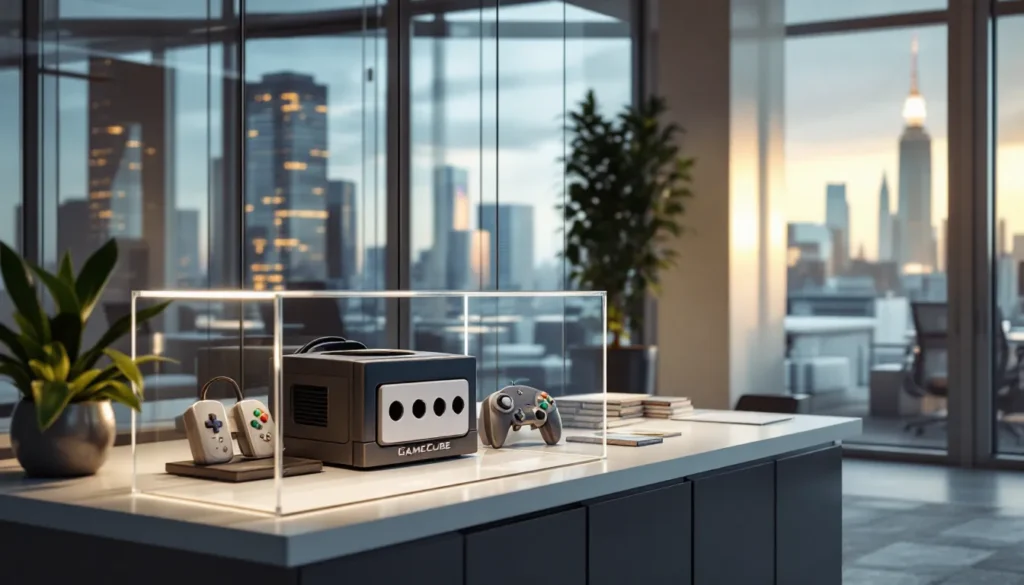
The Nintendo GameCube, sometimes affectionately called the “Nintendo Cube” by fans who remember its blocky, iconic design, holds a unique place in gaming history. Launched in an era dominated by the PlayStation 2’s market dominance and Microsoft’s ambitious Xbox debut, Nintendo’s cube-shaped console was more than just a piece of hardware. It was a statement, a risk, and eventually, a machine that delivered some of the most beloved games ever made.
Two decades later, the GameCube has evolved from a commercial underdog to a collector’s darling and a symbol of Nintendo’s bold design philosophy. Whether you’re revisiting childhood classics, hunting down rare special editions, or discovering what made this purple box so special, this guide covers everything you need to know about the GameCube in 2026, from its turbulent market battle to its enduring legacy and what it takes to collect and play these games today.
Key Takeaways
- The Nintendo GameCube, despite selling only 21.74 million units compared to PlayStation 2’s 155 million, is now celebrated as a collector’s favorite for its bold design and exceptional first-party game library.
- GameCube’s focused philosophy of prioritizing pure gaming performance over multimedia functionality set it apart, resulting in iconic titles like Metroid Prime, Wind Waker, and Super Smash Bros. Melee that still define Nintendo’s creative excellence.
- GameCube game prices have surged 150-200% between 2019 and 2023, with rare titles like Cubivore and Fire Emblem: Path of Radiance commanding $300-900 complete-in-box, making the Nintendo Cube a serious investment for collectors.
- The GameCube controller’s influence outlived the console itself, with Nintendo releasing official adapters for Wii U and Switch due to sustained demand from competitive Super Smash Bros. players and retro gaming enthusiasts.
- Dolphin Emulator has democratized access to the GameCube library, allowing gamers to experience these classic games in HD or 4K on modest hardware, introducing a new generation to what many regard as Nintendo’s creative peak.
What Is the Nintendo Cube (GameCube)?
The Nintendo GameCube is Nintendo’s fourth home console, released in Japan on September 14, 2001, followed by North America on November 18, 2001, and Europe on May 3, 2002. It’s officially called the GameCube, but the “Nintendo Cube” nickname stems from its literal cubic design, a stark departure from the sleek, rectangular consoles of its competitors.
The GameCube was Nintendo’s first disc-based home console, utilizing proprietary miniDVD discs with a 1.5 GB capacity. While smaller than the DVDs used by PlayStation 2 and Xbox, these discs were faster to read and cheaper to manufacture, though they limited storage for certain games.
Physically, the console measures just 5.9 inches on each side and weighs 3.3 pounds, making it one of the most compact home consoles ever built. Available initially in Indigo (the iconic purple) and Jet Black, with later releases in Platinum Silver and limited editions like the Spice Orange (Japan exclusive) and Tales of Symphonia bundle edition.
Under the hood, the GameCube packed impressive specs for its time: a custom IBM PowerPC Gekko CPU running at 486 MHz, an ATI Flipper GPU at 162 MHz, and 24 MB of main RAM plus 16 MB of audio RAM. This hardware gave developers the muscle to create visually stunning games that still hold up today, particularly in first-party Nintendo titles that prioritized art direction over raw polygon counts.
The Birth of the GameCube: Development and Launch
Design Philosophy and Hardware Specifications
Nintendo designed the GameCube with a singular focus: pure gaming performance. While Sony positioned the PS2 as a multimedia entertainment center with DVD playback, and Microsoft loaded the Xbox with hard drive functionality and PC-like architecture, Nintendo stripped away everything that didn’t directly serve gameplay.
This philosophy extended to the console’s physical design. Lead designer Kenichiro Ashida wanted a friendly, approachable aesthetic that contrasted with the “black box” electronics dominating living rooms. The result was that distinctive cube shape with a carrying handle molded into the back, a detail that screamed portability and accessibility.
The controller deserves special mention. Nintendo refined the analog stick placement from the N64, introduced a unique octagonal gate for precise directional input, and created the distinctive A-button-centric layout where the primary button is large and centered, with smaller B, X, and Y buttons positioned around it. The analog triggers with both analog and digital click points were revolutionary, especially for racing games.
Nintendo partnered with ArtX (later acquired by ATI) for graphics processing, and the collaboration resulted in impressive visual capabilities. The GameCube could push effects like real-time lighting, texture mapping, and particle effects that often exceeded what the technically superior Xbox could achieve in the hands of skilled developers.
Launch Lineup and Initial Reception
The GameCube launched with a respectable but not overwhelming lineup. Luigi’s Mansion served as the flagship title, a quirky choice given Mario’s absence from the launch day roster. Other day-one titles included Wave Race: Blue Storm, Super Monkey Ball (a surprise third-party hit from Sega), and Star Wars Rogue Squadron II: Rogue Leader, which showcased the console’s graphical prowess.
Critically, the response was positive. Gaming publications praised the hardware quality, controller design, and graphics capability. IGN gave the console an 8.9/10, while GameSpot lauded the “exceptional build quality and thoughtful design.”
Commercially, but, the launch revealed the uphill battle ahead. The GameCube sold approximately 3.8 million units worldwide by the end of 2001, respectable but overshadowed by the PS2’s existing install base of over 20 million and the Xbox’s aggressive marketing push. The $199 price point matched the Xbox but couldn’t overcome Sony’s momentum.
The absence of DVD playback, a deliberate design choice, became a liability as consumers increasingly valued multimedia functionality. Nintendo bet that focusing on gaming would differentiate the GameCube, but the market wanted convergence, not specialization.
GameCube’s Place in Console History: Competition and Market Performance
Battling the PlayStation 2 and Xbox
The sixth console generation was a three-way war, but it was never an even fight. Sony’s PlayStation 2 launched a year earlier (March 2000 in Japan, October 2000 in North America), giving it a massive head start. By the time GameCube and Xbox arrived, the PS2 had already established itself as the default platform for third-party developers.
Nintendo faced a perception problem: the GameCube was seen as the “kiddie” console. While Sony courted mature audiences with Grand Theft Auto, Metal Gear Solid, and Final Fantasy, and Microsoft pushed Halo’s gritty sci-fi warfare, Nintendo’s colorful aesthetics and family-friendly franchises struggled to shake the perception that the GameCube was for younger players.
This wasn’t entirely fair, the GameCube had plenty of mature content, including Resident Evil 4 (timed exclusive), Eternal Darkness: Sanity’s Requiem, and Metal Gear Solid: The Twin Snakes. But perception is reality in marketing, and Nintendo couldn’t overcome decades of brand positioning.
Third-party support eroded quickly. EA’s sports titles appeared on GameCube but with reduced features compared to PS2 and Xbox versions. Multiplatform releases often skipped the GameCube entirely, citing the miniDVD storage limitations and smaller install base. By 2003-2004, many major publishers had effectively abandoned the platform for anything but token releases.
Microsoft’s Xbox, meanwhile, carved out its niche with online gaming via Xbox Live and exclusive shooters. The GameCube’s online capabilities were limited to a handful of titles with the Broadband Adapter, and Nintendo showed little interest in building a unified online infrastructure.
Sales Figures and Commercial Impact
The numbers tell a stark story. Over its lifespan (2001-2007), the GameCube sold approximately 21.74 million units worldwide. Compare that to the PS2’s 155 million and the Xbox’s 24 million, and the GameCube’s commercial struggle becomes clear.
Regional breakdown showed the console performed best in North America (approximately 12.94 million units) and Japan (roughly 4.04 million), while Europe remained Nintendo’s weakest market with about 4.77 million units sold.
Nintendo responded to sluggish sales with aggressive price cuts. The console dropped to $149 in September 2002, then to $99 by September 2003, making it the cheapest sixth-gen console. These cuts drove volume but squeezed profit margins.
Even though commercial disappointment, Nintendo remained profitable throughout the GameCube era thanks to strong software sales and high attach rates. First-party titles like Super Smash Bros. Melee (7.09 million copies) and Mario Kart: Double Dash.. (6.96 million copies) demonstrated that Nintendo’s core audience remained fiercely loyal, even if the platform couldn’t expand beyond that base.
Iconic GameCube Games That Defined a Generation
First-Party Masterpieces
Nintendo’s first-party output on GameCube represents some of the company’s finest work. These titles didn’t just sell consoles, they defined what Nintendo gaming meant in the early 2000s.
Super Smash Bros. Melee (2001) remains the competitive Smash standard even in 2026. Its tight controls, deep mechanics, and lightning-fast gameplay created a competitive scene that refuses to die. Melee tournaments still draw thousands of entrants, and the game’s frame-perfect techniques like wavedashing and L-canceling are studied like sacred texts.
The Legend of Zelda: The Wind Waker (2002, later 2003 in some regions) was controversial at launch for its cel-shaded “toon Link” aesthetic, but it’s now recognized as one of the series’ artistic peaks. The ocean exploration, expressive animation, and emotional story beat many “realistic” games of the era. The 2013 HD remaster on Wii U vindicated the original vision.
Metroid Prime (2002) successfully translated the 2D Metroid formula into first-person 3D, a transition many thought impossible. Retro Studios’ debut title featured atmosphere, exploration, and world-building that rivaled any game on any platform. The scanning mechanic and non-linear progression influenced countless games afterward.
Resident Evil 4 (2005) was initially a GameCube exclusive and revolutionized third-person action games. The over-the-shoulder camera, precision aiming, and dynamic enemy encounters created a template still used today. Though it later ported to other platforms, RE4 was synonymous with GameCube for years.
Other first-party highlights include:
- Super Mario Sunshine (2002) – Mario’s tropical vacation with FLUDD
- F-Zero GX (2003) – Brutally difficult futuristic racing
- Paper Mario: The Thousand-Year Door (2004) – Peak Paper Mario before the series shifted direction
- Fire Emblem: Path of Radiance (2005) – The series’ first international 3D entry
- Pikmin and Pikmin 2 – Shigeru Miyamoto’s charming strategy-action hybrids
Hidden Gems and Cult Classics
Beyond the blockbusters, the GameCube library is stuffed with underappreciated gems that have gained cult followings.
Eternal Darkness: Sanity’s Requiem (2002) was Nintendo’s mature-rated psychological horror masterpiece. The sanity effects, including fake system crashes, volume changes, and fourth-wall-breaking scares, were unprecedented. It’s now one of the most sought-after GameCube titles.
Skies of Arcadia Legends (2003) brought the Dreamcast JRPG classic to GameCube with additional content. The sky pirate adventure, colorful world, and ship battles made it the definitive version of an already excellent game.
Viewtiful Joe (2003) launched Capcom’s stylish side-scrolling beat-’em-up with VFX-powered gameplay. The cel-shaded visuals and creative slow-mo and speed-up mechanics created something truly unique.
Other cult favorites worth hunting:
- Chibi-Robo. – Wholesome robot cleaning simulator
- Lost Kingdoms and Lost Kingdoms II – FromSoftware’s card-based action RPGs
- Odama – Pinball-strategy hybrid with voice controls
- Battalion Wars – Real-time tactics from the Advance Wars universe
- Custom Robo – Arena battler with deep customization
Many of these titles now command premium prices in the collector’s market, especially complete-in-box copies with original inserts and manuals.
Unique Features and Innovations of the GameCube
The Game Boy Advance Connectivity
One of the GameCube’s most ambitious features was Game Boy Advance connectivity via the GBA link cable. This allowed the handheld to function as a second screen, controller, or companion device for compatible GameCube games.
The implementation varied wildly. The Legend of Zelda: Four Swords Adventures required up to four GBAs for multiplayer, making it prohibitively expensive but incredibly fun when you could gather the hardware. The Legend of Zelda: The Wind Waker used the GBA as a Tingle Tuner for helpful hints and item drops.
Final Fantasy Crystal Chronicles built its entire co-op experience around GBA connectivity, with each player using a GBA to manage their inventory privately during dungeon crawling. Animal Crossing allowed pattern design on the GBA and transfer to the GameCube version.
While innovative, the feature never reached mass adoption due to the cost barrier, each player needed their own GBA and link cable. By 2004-2005, as the Nintendo DS launched, GBA connectivity quietly faded away.
The concept, but, proved influential. Nintendo’s later dual-screen experiments with the DS and the Wii U gamepad can trace their conceptual DNA back to GameCube-GBA linking.
Controller Design and the WaveBird Wireless Controller
The GameCube controller is often cited as one of the best controller designs ever made. Its ergonomic shape, unique button layout, and analog shoulder triggers created a feel that many gamers still prefer.
The octagonal gates around the analog sticks provided precise cardinal and diagonal inputs, crucial for competitive Smash Bros. and fighting games. The asymmetric button layout, with the large A button surrounded by smaller B, X, and Y buttons, guided players toward the primary action without looking down.
The analog triggers with both analog range and a digital click at the bottom gave racing and shooting games nuanced control. Full trigger pull in games like Mario Kart: Double Dash.. produced different results than partial pressure.
In 2002, Nintendo released the WaveBird Wireless Controller, a revolutionary accessory at a time when wireless controllers were rare and usually laggy. The WaveBird used radio frequency (RF) instead of infrared, allowing play without line-of-sight and with minimal latency. It ran on two AA batteries and featured 16 channels to avoid interference.
The WaveBird was expensive ($35-40 versus $25 for wired controllers) and lacked rumble functionality, but for many players, the wireless freedom was worth it. Modern competitive Smash players still debate whether WaveBird has acceptable latency for tournament play.
Modern gamers can still experience the GameCube controller through official Switch adaptations that bring the classic layout to current-generation hardware.
Collecting Nintendo GameCube in 2026: Pricing and Rarity Guide
Console Variants and Special Editions
The GameCube released in several color variants and special editions that now command different prices in the collector’s market.
Standard colors:
- Indigo (Purple) – The most iconic and common
- Jet Black – Common, especially in Japan
- Platinum (Silver) – Released later, moderately common
- Spice Orange – Japan exclusive, highly sought after (expect $200-400 for console only)
Limited editions and bundles:
- Tales of Symphonia Edition – Japan only, maroon console with matching controller ($300-500)
- Resident Evil 4 Edition – Japan exclusive silver console with RE4 design ($400-600)
- Panasonic Q – DVD-playing GameCube hybrid sold only in Japan (2001-2003), extremely rare ($800-1500+ depending on condition)
- Pokemon XD Edition – Platinum console with Pokemon XD branding ($150-250)
Console condition heavily impacts value. A mint condition console with original box, inserts, cables, and controller can fetch 2-3x the price of a console-only unit. Look for systems with minimal yellowing on the plastic and clean, working controller ports and disc drives.
In 2026, a standard used Indigo or Black GameCube console with controller and cables typically runs $80-120. Complete-in-box systems range from $150-250 depending on condition.
Most Valuable Games and Accessories
GameCube game prices have exploded since 2020, with certain titles reaching astronomical values. Here are the current heavy hitters as of early 2026:
Top-tier rarities ($200+):
- Cubivore: Survival of the Fittest – $250-400 (loose), $600-900 (CIB)
- Skies of Arcadia Legends – $150-200 (loose), $300-450 (CIB)
- Fire Emblem: Path of Radiance – $180-250 (loose), $350-550 (CIB)
- Gotcha Force – $200-300 (loose), $500-800 (CIB)
- Chibi-Robo. – $100-150 (loose), $250-400 (CIB)
Mid-tier collectibles ($50-150):
- Paper Mario: The Thousand-Year Door – $70-90 (loose), $150-200 (CIB)
- The Legend of Zelda: Twilight Princess – $60-80 (loose), $120-180 (CIB)
- Super Smash Bros. Melee – $50-65 (loose), $100-140 (CIB)
- Metroid Prime 1 & 2 – $35-50 each (loose), $70-110 (CIB)
Valuable accessories:
- Game Boy Player with startup disc – $180-280 (the disc alone is $100-200)
- WaveBird Wireless Controller with receiver – $80-120
- Component cables (official Nintendo) – $200-350 due to extreme rarity
- Broadband Adapter – $120-200
Prices fluctuate based on market trends, but overall values have stabilized after the pandemic-era surge. According to data tracked by collectors on retro gaming forums, GameCube values increased approximately 150-200% between 2019 and 2023, with more moderate 10-15% annual growth since then.
Where to Buy and What to Look For
Acquiring GameCube hardware and games in 2026 requires patience and knowledge to avoid overpaying or getting scammed.
Buying venues:
Online marketplaces:
- eBay – Largest selection, highest prices, watch for reproductions
- Facebook Marketplace / Craigslist – Best deals if you can find local sellers who don’t know current values
- Mercari / OfferUp – Growing platforms with competitive pricing
- r/GameSale (Reddit) – Community-driven sales with reputation systems
Retail options:
- Local retro game stores – Prices are retail but you can inspect condition: support local businesses
- DKOldies, Lukie Games – Online retro retailers with guarantees but premium pricing
- GameStop (select locations) – Some stores still carry retro inventory at varying prices
Red flags to watch for:
- Reproduction games – Check disc printing quality: reproductions often have blurry or off-color labels
- Disc resurfacing – Heavy resurfacing can make discs unreadable: check for even surface and no deep scratches
- Yellowed consoles – UV exposure causes yellowing: purely cosmetic but reduces value
- Missing disc drive parts – The plastic disc tray lid often breaks: replacements are cheap but indicate hard use
- Third-party memory cards – Often corrupt: stick with official Nintendo memory cards
Inspection tips when buying locally:
- Boot the console and test all controller ports
- Check disc reading with multiple games if possible
- Verify memory card saves and deletes correctly
- Test the Game Boy Player if included (and ensure you get the startup disc)
- Smell inside vents for smoke damage (serious issue that’s hard to remove)
For serious collectors, joining communities like r/Gamecube or GameCube-specific Discord servers provides real-time price alerts and authenticity help.
Playing GameCube Games Today: Emulation and Modern Options
Official Backward Compatibility on Wii
The Nintendo Wii (2006) included full backward compatibility with GameCube games, controllers, and memory cards. Early Wii models (RVL-001) featured four GameCube controller ports on top and two memory card slots under a flap.
This made the Wii an excellent GameCube player, with the bonus of progressive scan support through component cables. Many GameCube games looked sharper on Wii than on original hardware, especially on HDTVs.
But, later Wii revisions removed GameCube support:
- Wii Family Edition (2011, model RVL-101) – No GameCube controller ports or memory card slots
- Wii Mini (2012, model RVL-201) – No GameCube support
The Wii U dropped GameCube backward compatibility entirely, even though being powerful enough to run the games. This was a deliberate business decision by Nintendo.
If you own an original Wii model, it remains the most affordable official way to play GameCube games, especially since Wiis are still readily available for $40-80 in working condition.
Emulation Setup and Legal Considerations
GameCube emulation has matured significantly, with Dolphin Emulator standing as the gold standard. Dolphin runs on Windows, macOS, Linux, and even Android devices, offering features that surpass original hardware.
Dolphin capabilities:
- HD rendering – Upscale games to 1080p, 4K, or even 8K
- Enhanced textures – Community texture packs dramatically improve graphics
- Save states – Save anywhere, not just at save points
- Netplay – Online multiplayer for local-only games
- Controller support – Use any modern controller, including authentic GameCube controllers via USB adapters
- Performance enhancements – Remove slowdown and increase frame rates where possible
Hardware requirements (as of 2026):
- Minimum: Dual-core CPU at 3.0+ GHz, 4GB RAM, integrated graphics
- Recommended: Quad-core CPU, 8GB RAM, dedicated GPU (even budget cards work)
- Optimal: Modern 6-8 core CPU, 16GB RAM, mid-range GPU for 4K rendering
Most games run flawlessly on modest hardware. Demanding titles like F-Zero GX and Rogue Squadron II require stronger CPUs due to emulation overhead.
Legal considerations:
Emulation exists in a legal gray area. The Dolphin software itself is completely legal, emulators are protected tools. But, obtaining game files (ISOs) is where legality gets murky.
Technically legal:
- Dumping your own GameCube discs using a Wii with homebrew software
- Dumping BIOS files from your own console
Legally questionable:
- Downloading ISOs from the internet, even for games you own physically
- Sharing or distributing ISOs
Nintendo’s official position is that downloading ROMs/ISOs is illegal copyright infringement, regardless of ownership. In practice, enforcement targets distribution sites, not individual users.
For those interested in modern ways to experience classic Nintendo hardware with current conveniences, there are various official controller options that bridge retro and contemporary gaming.
Why the GameCube’s Legacy Endures
Twenty-plus years removed from its launch, the GameCube’s reputation has undergone a complete transformation. What was once dismissed as a commercial failure is now celebrated as a creative peak for Nintendo.
Several factors contribute to this legacy:
Unwavering software quality. Nintendo’s first-party output on GameCube was consistently excellent. When third parties abandoned the platform, Nintendo doubled down on quality over quantity. Nearly every major Nintendo franchise received at least one, and often multiple, standout entries.
Design confidence. The GameCube represents Nintendo at its most willing to take risks. The cube form factor, the handle, the miniDVD format, the GBA connectivity, these were bold choices that prioritized gaming experience over market trends. While this hurt sales, it created a distinct identity that resonates with enthusiasts.
Controller perfection. The GameCube controller’s enduring popularity speaks volumes. Super Smash Bros. tournaments standardized on it for nearly two decades. Nintendo released official GameCube controller adapters for Wii U and Switch specifically because demand never died. A great controller outlives its console.
Competitive gaming roots. Melee’s competitive scene kept GameCube relevant long after Nintendo moved on. Major tournaments like Genesis, Shine, and Smash Summit feature hundreds of CRT televisions and GameCubes, creating time capsules of early 2000s gaming. This scene introduced younger generations to the console.
The cycle of nostalgia. Gamers who grew up with the GameCube (born roughly 1990-2000) are now adults with disposable income and fond memories. This demographic drives collecting trends, streaming content, and cultural reassessment of the era.
Emulation accessibility. Dolphin’s maturity made GameCube gaming more accessible than ever. Someone with a modest laptop can experience the entire library in HD with quality-of-life improvements. This introduced the library to audiences who never owned the original hardware.
Reflections from the gaming community demonstrate this shift. What was once the “purple lunchbox” that lost to PlayStation is now remembered as the console that delivered Metroid Prime, Wind Waker, Melee, and Resident Evil 4. Market share doesn’t determine legacy, the games do.
Industry analysis from sites like Nintendo Life frequently ranks GameCube-era titles among Nintendo’s best work, and retrospectives consistently highlight how the console’s “failure” freed Nintendo from chasing trends and let them focus on what they do best: making exceptional games.
Conclusion
The Nintendo GameCube sold fewer units than its competitors, lost billions in market share, and pushed Nintendo toward reconsidering their entire console strategy. And yet, it’s remembered with more affection than the systems that outsold it.
That’s because the GameCube era represents something increasingly rare in modern gaming: uncompromising focus on the experience over everything else. No multimedia distractions, no corporate hedging, no chasing trends. Just a weird purple cube with a handle and some of the best games ever made.
Whether you’re collecting hardware, discovering these games for the first time through emulation, or still running your childhood console, the GameCube remains worth celebrating, not even though its commercial struggle, but because of what Nintendo created when the pressure was on to deliver nothing but excellence.
The market declared it a loser. Gamers knew better.