
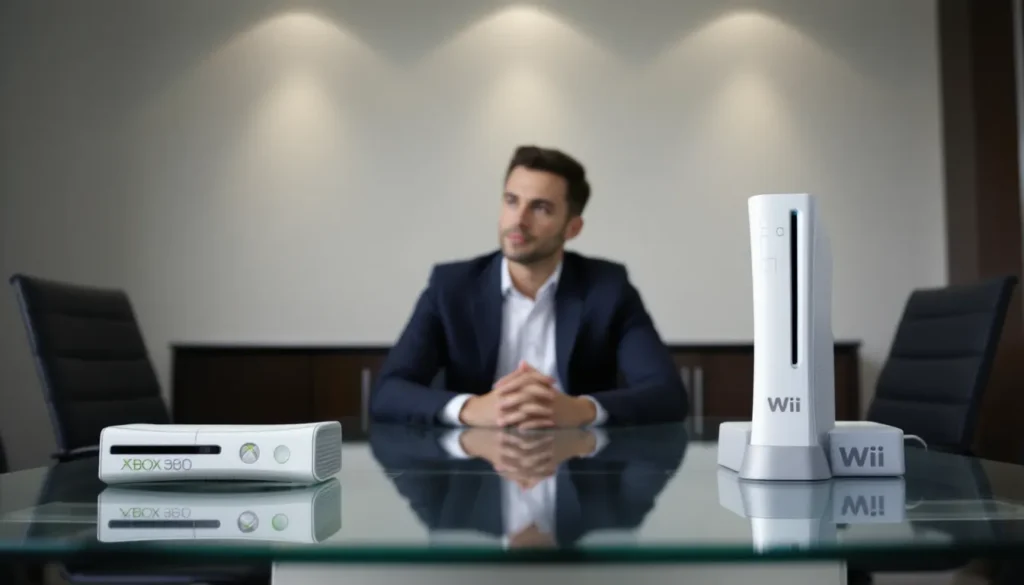
If you’ve ever heard someone mention a “Nintendo 360,” you’ve stumbled into one of gaming’s most persistent naming confusions. Spoiler: there’s no such thing as a Nintendo 360. What people usually mean is Microsoft’s Xbox 360, a seventh-generation console that dominated living rooms from 2005 to 2013. But how did two completely different companies, Nintendo and Microsoft, get their wires crossed in the minds of gamers and non-gamers alike?
This mix-up happens more often than you’d think, especially among casual players, parents shopping for gifts, or anyone who hasn’t kept up with console generations. The confusion isn’t just a harmless mistake: it reflects how brand names, marketing, and casual gaming culture sometimes collide in weird ways. This article clears up the misconception, explores why it happens, and breaks down what each company actually offered during that console generation. Whether you’re trying to identify a mystery console in your attic or just want to understand the gaming landscape better, let’s untangle this once and for all.
Key Takeaways
- There is no Nintendo 360—the confusion stems from Microsoft’s Xbox 360, which people sometimes incorrectly attribute to Nintendo due to brand familiarity and overlapping console generations.
- The Xbox 360 and Nintendo Wii were fundamentally different consoles: the Xbox 360 prioritized online multiplayer, powerful hardware, and exclusive shooters, while the Wii focused on motion controls, family-friendly gaming, and local accessibility.
- Xbox Live revolutionized console online gaming by introducing unified voice chat, achievements, and seamless matchmaking, setting the standard that competitors still follow today.
- The Xbox 360 suffered from the infamous Red Ring of Death hardware failure affecting early models, but Microsoft’s extended warranty and hardware revisions (Jasper, S, and E models) eventually restored consumer trust.
- In 2026, the Nintendo Switch is Nintendo’s current gaming platform with over 139 million units sold, while the Xbox 360 is now retro hardware best enjoyed through backward compatibility on Xbox Series X|S.
- Console naming confusion is common across the industry (Wii vs. Wii U, Xbox One vs. Xbox 360, PlayStation vs. PSP), highlighting how marketing and brand recognition can obscure product distinctions.
What Is the “Nintendo 360”? Clearing Up the Misconception
The Origin of the Nintendo 360 Confusion
The “Nintendo 360” doesn’t exist, it never has, and Nintendo has never released a console with that name. The confusion stems from Microsoft’s Xbox 360, which launched in November 2005 as the successor to the original Xbox. The Xbox 360 name came from Microsoft’s branding strategy: the “360” was meant to suggest a complete, all-encompassing entertainment experience (360 degrees of entertainment). Nintendo, meanwhile, launched the Wii in 2006, a motion-controlled console that took a completely different design and marketing approach.
So where does “Nintendo 360” come from? It’s a linguistic blend that happens when people conflate two dominant gaming brands from the same era. The Xbox 360 was everywhere during the mid-to-late 2000s, and Nintendo was the most recognizable name in gaming for decades. When someone who isn’t deeply into gaming tries to recall console names, they sometimes mash up what they’ve heard: “Nintendo” (the familiar brand) and “360” (the memorable number from Xbox marketing).
This mix-up was especially common among parents, grandparents, and retailers during holiday shopping seasons. Kids would ask for an Xbox 360, but the adult would hear “Nintendo” and assume it’s all the same thing. Gaming forums from 2006–2010 are littered with stories of gift-giving disasters where someone received the wrong console because of this exact confusion.
Why People Mistake Xbox 360 for a Nintendo Console
The core reason for this confusion is brand dominance and familiarity. Nintendo has been a household name since the NES era (1985), and for many older generations, “Nintendo” became synonymous with video games in general, much like how “Kleenex” means tissue or “Google” means search. When Xbox entered the market in 2001, it was the new kid on the block, and casual observers didn’t always distinguish between gaming brands.
Another factor is the target audience overlap. Both the Xbox 360 and Nintendo’s Wii were aimed at living room entertainment, though with different philosophies. The Wii focused on family-friendly motion gaming, while the Xbox 360 leaned into online multiplayer and graphics performance. But to someone outside the gaming bubble, they were just “the new game consoles.”
Finally, numerical naming conventions played a role. Nintendo had used numbers before (Nintendo 64), so hearing “360” attached to a console didn’t sound unreasonable to someone unfamiliar with the brands. The Xbox 360’s marketing was aggressive and widespread, and the “360” branding stuck in people’s heads, even if they mentally filed it under the wrong company.
Xbox 360 vs. Nintendo Consoles: A Side-by-Side Comparison
Xbox 360 Overview: Microsoft’s Seventh-Generation Powerhouse
The Xbox 360 was Microsoft’s second console, launching November 22, 2005, in North America. It featured a custom tri-core PowerPC processor, ATI Xenos GPU, and 512 MB of shared RAM, serious hardware for the time. The console came in multiple SKUs: the Core, Premium, Elite, and later the slim “S” and “E” models. It supported HD gaming (up to 1080p), had a built-in DVD drive, and offered optional hard drives ranging from 20 GB to 320 GB.
What set the Xbox 360 apart was Xbox Live, Microsoft’s online gaming service. Xbox Live transformed console multiplayer with unified voice chat, achievements, downloadable content, and the Xbox Live Arcade for indie and retro games. Major exclusives included Halo 3, Gears of War, Forza Motorsport, and Fable II. The platform also secured timed exclusives and DLC deals, giving it an edge in the competitive multiplayer space.
But, the Xbox 360’s legacy is also tied to the infamous Red Ring of Death (RROD), a hardware failure that plagued early models. Microsoft extended warranties and revised hardware multiple times to address overheating and GPU issues, but the problem damaged the console’s reputation during its first few years.
Nintendo’s Actual Seventh-Generation Console: The Wii
Nintendo’s answer to the seventh generation was the Wii, released November 19, 2006. Instead of competing on raw power, Nintendo pivoted to motion controls with the Wii Remote (Wiimote), a controller that used accelerometers and an infrared sensor bar to track movement. The Wii’s hardware was significantly weaker than the Xbox 360 or PlayStation 3, using a single-core IBM PowerPC CPU and an ATI Hollywood GPU, but it was cheap, efficient, and designed for accessibility.
The Wii became a cultural phenomenon, selling over 101 million units worldwide. Its killer app was Wii Sports, bundled with the console in most regions, which introduced motion gaming to everyone from kids to retirement homes. Other major exclusives included Super Mario Galaxy, The Legend of Zelda: Twilight Princess, Mario Kart Wii, and Super Smash Bros. Brawl. The Wii also featured Virtual Console, allowing players to download classic NES, SNES, and N64 games.
Nintendo prioritized local multiplayer and family-friendly content, contrasting sharply with the Xbox 360’s focus on online competitive gaming and mature titles. The Wii’s lower price point ($249 at launch vs. Xbox 360’s $299–$399) also made it more accessible.
Key Differences in Hardware, Games, and Design Philosophy
Here’s a direct comparison of the Xbox 360 and Wii:
Hardware:
- Xbox 360: Tri-core CPU, 512 MB RAM, HD output (720p/1080p), DVD drive, optional hard drive
- Wii: Single-core CPU, 88 MB RAM (24 MB main + 64 MB GPU), SD output (480p max), DVD drive (no playback), internal 512 MB flash storage + SD card slot
Controllers:
- Xbox 360: Traditional dual-analog controller with triggers, wired and wireless options
- Wii: Motion-sensing Wii Remote with IR pointer, nunchuk attachment, optional Classic Controller for traditional gameplay
Online Services:
- Xbox 360: Xbox Live Gold required for multiplayer ($50/year), robust online infrastructure, achievements, party chat
- Wii: Free online via Nintendo Wi-Fi Connection, limited features, friend codes required, no unified voice chat
Game Library:
- Xbox 360: Heavy emphasis on FPS, action, and mature-rated games (Call of Duty, Halo, Gears of War, Mass Effect)
- Wii: Family-friendly, party games, Nintendo first-party franchises, motion-control gimmicks
Design Philosophy:
- Xbox 360: Power, online connectivity, hardcore gamers, multimedia hub (Netflix, streaming)
- Wii: Accessibility, motion gaming, local multiplayer, expanding the gaming audience
Both consoles succeeded in their own lanes, but they couldn’t be more different in execution.
Nintendo’s Console Timeline: From NES to Switch
The Nintendo Entertainment System (NES) Era
Nintendo’s home console journey began with the Famicom in Japan (1983) and the Nintendo Entertainment System (NES) in North America (1985). The NES revived the video game industry after the 1983 crash, introducing iconic franchises like Super Mario Bros., The Legend of Zelda, and Metroid. The NES sold 61.91 million units worldwide and established Nintendo as the dominant force in gaming.
The NES’s successor, the Super Nintendo Entertainment System (SNES), launched in 1990 (1991 in North America). It featured 16-bit graphics, Mode 7 pseudo-3D effects, and a legendary library including Super Mario World, The Legend of Zelda: A Link to the Past, Super Metroid, and Chrono Trigger. The SNES sold 49.1 million units and competed fiercely with Sega’s Genesis.
SNES, N64, and GameCube: Nintendo’s Evolution
Nintendo entered the 3D era with the Nintendo 64 (N64) in 1996. The N64 used cartridges instead of CDs, a decision that limited third-party support but allowed for faster load times and more durable media. It introduced the analog stick and four controller ports as standard, making it ideal for local multiplayer. Super Mario 64, The Legend of Zelda: Ocarina of Time, GoldenEye 007, and Super Smash Bros. defined the platform. The N64 sold 32.93 million units, successful, but trailing Sony’s PlayStation.
The GameCube arrived in 2001, featuring compact mini-DVDs, a unique controller design, and solid first-party titles like Super Smash Bros. Melee, Metroid Prime, and The Legend of Zelda: The Wind Waker. Even though its quality, the GameCube struggled against the PlayStation 2 and Xbox, selling only 21.74 million units. Nintendo’s brand was strong, but it was losing ground in the home console wars.
Wii, Wii U, and Nintendo Switch: Modern Nintendo Gaming
The Wii (2006) was Nintendo’s gamble on motion controls and accessibility, and it paid off massively. With 101.63 million units sold, it outsold both the Xbox 360 and PlayStation 3. The Wii proved that innovation in input methods could trump raw hardware specs.
The Wii U (2012) attempted to build on that success with a tablet-like GamePad controller featuring a touchscreen and dual-screen gameplay. Unfortunately, confusing marketing, weak third-party support, and a lack of compelling launch titles led to poor sales, only 13.56 million units. Many consumers thought the Wii U was an accessory for the Wii, not a new console. Even though the commercial failure, the Wii U introduced concepts that would define the Switch, and it had excellent exclusives like Super Mario 3D World, Splatoon, and The Legend of Zelda: Breath of the Wild (which also launched on Switch).
The Nintendo Switch launched in March 2017 and became Nintendo’s most successful home console. Its hybrid design, functioning as both a portable handheld and a TV-connected console, resonated with players. As of early 2026, the Switch has sold over 139 million units. Major exclusives include The Legend of Zelda: Breath of the Wild, Super Mario Odyssey, Animal Crossing: New Horizons, Splatoon 3, and The Legend of Zelda: Tears of the Kingdom. The Switch proved Nintendo’s ability to innovate and dominate, even without matching competitors’ hardware specs.
Common Gaming Console Naming Confusions and Mix-Ups
Why Console Names Get Confused
Console naming conventions have always been a minefield. Companies use numbers, letters, and abstract words to differentiate generations, but not every strategy works. Sometimes names are too similar (Wii vs. Wii U), sometimes they’re too vague (Xbox One released after Xbox 360, not before), and sometimes they just don’t stick with the general public.
Casual consumers often rely on brand recognition rather than specific model names. “PlayStation” or “Nintendo” might be all someone remembers, leading to mix-ups when they try to recall exact console names. Retailers also contribute to confusion by mislabeling products or using shorthand that blurs distinctions.
Another factor is generational overlap. When multiple consoles from different companies release within months of each other, like the Xbox 360, PlayStation 3, and Wii, people who aren’t tracking launch dates can easily conflate details. Marketing campaigns, word-of-mouth, and even autocorrect on phones can spread incorrect names.
Other Frequently Confused Console Names
The “Nintendo 360” isn’t the only victim of naming confusion. Here are other common mix-ups:
Wii vs. Wii U: This is arguably the worst console naming decision in history. Many consumers thought the Wii U was just a new controller or accessory for the original Wii, not a separate console. Nintendo’s marketing failed to communicate the difference, contributing to the Wii U’s commercial failure.
Xbox One vs. Xbox 360: Microsoft’s decision to name the successor to the Xbox 360 the “Xbox One” confused many people. Why go from 360 back to “One”? The logic was to position it as an all-in-one entertainment system, but it sounded like a step backward. Parents and gift-givers often mixed up which was the newer console.
PlayStation vs. PSP vs. PS Vita: Casual shoppers sometimes confused Sony’s handheld systems (PSP and PS Vita) with home PlayStation consoles, especially when trying to buy games or accessories.
Nintendo DS vs. 3DS vs. 2DS: Nintendo’s handheld line has its own confusion. The 3DS added stereoscopic 3D, but the 2DS removed it while still playing 3DS games. The naming implied a downgrade, even though it was just a cheaper alternative.
Console manufacturers have gotten better at clarity in recent years, PlayStation 4 to PlayStation 5 is straightforward, and the Switch is distinctive, but legacy confusion still pops up, especially in secondhand markets and retro gaming communities.
What Made the Xbox 360 So Popular?
Exclusive Games and Xbox Live Revolution
The Xbox 360’s dominance in the seventh generation came down to two pillars: exclusive games and Xbox Live. Microsoft invested heavily in first-party and second-party studios, securing franchises that defined the console. Halo 3 (2007) was a cultural event, breaking entertainment records and proving that console shooters could rival PC FPS experiences. Gears of War (2006) showcased the Unreal Engine 3 and set a new standard for cover-based shooters.
Other standout exclusives included Forza Motorsport (the definitive console racing sim), Fable II, Mass Effect (timed exclusive), Alan Wake, and Left 4 Dead (console exclusive). The Xbox 360 also became the go-to platform for multiplatform games like Call of Duty and Grand Theft Auto IV, often running better than PS3 versions and securing timed DLC deals.
But the real revolution was Xbox Live. For $50/year, players got unified voice chat, friend lists, achievements (Gamerscore became a badge of honor), and seamless matchmaking across all games. Xbox Live Arcade brought indie hits like Braid, Limbo, and Castle Crashers to consoles. Party chat, introduced in 2008, allowed friends to talk across different games, a feature that seems basic now but was groundbreaking then. Many Xbox-focused outlets covered the platform’s achievements ecosystem extensively, highlighting how it changed player engagement.
Xbox Live set the standard for console online services, and even today, PlayStation Network and Nintendo Switch Online are measured against it.
The Red Ring of Death and Hardware Challenges
No discussion of the Xbox 360 is complete without addressing the Red Ring of Death (RROD). Early Xbox 360 models suffered catastrophic hardware failure rates, some estimates put it as high as 23–54% of consoles. The RROD was caused by overheating, poor thermal design, and manufacturing defects, particularly affecting the GPU and solder joints.
When an Xbox 360 failed, three red lights would appear around the power button instead of the normal green ring, hence the nickname. Microsoft initially downplayed the issue, but after widespread complaints and media coverage, they extended warranties to three years for RROD-specific failures and took a $1.15 billion charge to cover repairs and replacements.
Microsoft released multiple hardware revisions to address the problem: the Jasper chipset (2008) reduced failure rates, and the Xbox 360 S (2010) completely redesigned the internals with better cooling, a quieter fan, and integrated Wi-Fi. The Xbox 360 E (2013) was a final slim revision released alongside the Xbox One.
Even though the RROD fiasco, the Xbox 360 sold 84 million units worldwide. Microsoft’s handling of the crisis, extending warranties and improving hardware, helped rebuild trust. The platform’s software strengths and Xbox Live’s dominance kept players loyal, even through hardware headaches.
How to Identify What Console You Actually Have
Physical Identification Tips for Nintendo vs. Xbox Consoles
If you’ve got a mystery console and you’re not sure whether it’s a Nintendo or Microsoft product, here are the quickest ways to tell:
Xbox 360 Identification:
- Shape: The original Xbox 360 (2005–2010) has a curved, white or black exterior with a concave side and glossy panels. The Xbox 360 S (2010–2013) is slimmer, matte black, with angular vents and a glossy top. The Xbox 360 E (2013–2016) looks similar to the Xbox One with a flat, rectangular design.
- Logos: The Xbox 360 always features the green Xbox logo (four quadrants forming an “X”) and “Xbox 360” branding prominently on the console or faceplate.
- Controller: The Xbox 360 controller is symmetrical with offset analog sticks (left stick high, right stick low), a central Xbox Guide button (green glowing circle), and distinctive black-and-white color schemes.
- Ports: The front has a disc tray (early models) or slot-loading drive (S and E models), USB ports, and a proprietary memory card or hard drive slot on top or side.
Nintendo Wii Identification:
- Shape: The Wii is a small, vertical white rectangle (about the size of three DVD cases stacked). It can also be placed horizontally with a stand.
- Logos: “Wii” is printed on the front in gray or black. The Nintendo logo appears on top or front.
- Controller: The Wii Remote is a white, TV-remote-shaped controller with a wrist strap, directional pad, A/B buttons, and motion sensors. It’s unmistakable compared to traditional controllers.
- Ports: The front has a slot-loading disc drive, SD card slot, and a flap covering GameCube controller and memory card ports (on older models).
Other Nintendo Consoles:
- Nintendo 64: Bulky, charcoal or colored plastic, four controller ports on the front, cartridge slot on top.
- GameCube: Small, cube-shaped, handle on the back, proprietary mini-DVD drive on top.
- Switch: Tablet-like screen with detachable Joy-Con controllers on the sides, or a docked version connected to a TV.
Checking Console Branding and Logos
The easiest foolproof method is to look at the branding on the console itself. Every console has the manufacturer’s name and model printed somewhere:
- Xbox 360: Check the faceplate, top panel, or back. You’ll see “Xbox 360,” “Microsoft,” and model numbers like “Xbox 360 S” or “Xbox 360 E.”
- Nintendo Consoles: Look for “Nintendo” and the specific console name (“Wii,” “Nintendo 64,” “GameCube,” “Switch”) printed on the device.
You can also check the power supply. Xbox 360 power bricks are large, external, and often labeled with Microsoft branding. Nintendo consoles use smaller, proprietary AC adapters with Nintendo logos.
If you’re still unsure, power on the console. The Xbox 360 displays the Xbox 360 dashboard with the green Xbox orb logo and blade/NXE/Metro interface. The Wii boots to the Wii Menu with the distinctive channel layout and “Wii” logo. Many gaming sites like IGN have console identification guides and unboxing videos that can help if you’re stuck.
Should You Buy an Xbox 360 or a Nintendo Console in 2026?
Xbox 360 in 2026: Retro Gaming and Collectibility
In 2026, the Xbox 360 is firmly in the retro category. Microsoft ended production in 2016 and shut down the Xbox 360 Store in July 2024, meaning you can no longer purchase digital games or DLC (though previously purchased content remains downloadable). Physical disc-based games are still playable, and the console supports backward compatibility with original Xbox titles.
Is it worth buying an Xbox 360 now? If you’re into retro gaming or collecting, absolutely. You can pick up a used Xbox 360 S or E model for $50–$100, and physical games are dirt cheap, many classics go for under $10. The library is massive: over 1,200 games, including exclusives that never got ported (Halo 3, Gears of War trilogy, Forza Motorsport 4, Fable II) and multiplatform titles that defined the generation.
But, there are downsides. Xbox Live multiplayer is mostly dead for older games: servers for titles like Halo 3 and Gears of War 2 were shut down or have tiny player counts. Achievement hunting is still possible offline, but online features are limited. Also, hardware reliability remains a concern, even revised models can fail, and replacement parts are getting scarce.
If you want to play Xbox 360 games in 2026, **backward compatibility on Xbox Series X
|
S** is the better option. Hundreds of Xbox 360 titles run on modern Xbox hardware with improved resolution, frame rates, and Auto HDR. You can often find digital versions cheap during sales, and you’ll avoid hardware headaches. Coverage from outlets like Windows Central frequently highlights which Xbox 360 games run best on modern hardware.
Bottom line: Buy an Xbox 360 for nostalgia, collecting, or if you want the authentic experience. Otherwise, play backward-compatible titles on Series X
|
S.
Nintendo Switch and Modern Nintendo Gaming Options
Nintendo’s current platform is the Switch, and it’s still going strong in 2026. While rumors of a “Switch 2” or successor persist, Nintendo hasn’t officially announced a next-gen console as of March 2026. The Switch offers the best of Nintendo’s first-party lineup: The Legend of Zelda, Super Mario, Splatoon, Animal Crossing, Pokémon, and more.
The Switch comes in three models:
- Nintendo Switch OLED: Enhanced 7-inch OLED screen, better kickstand, 64 GB storage, $349.
- Standard Nintendo Switch: 6.2-inch LCD, detachable Joy-Cons, dock included, $299.
- Nintendo Switch Lite: Handheld-only, smaller, no detachable controllers, $199.
If you’re buying a Nintendo console in 2026, the Switch is the obvious choice. Its library is enormous, it gets regular new releases, and online services are cheap ($19.99/year for Nintendo Switch Online, $49.99/year for Expansion Pack with N64/Genesis games). The Switch also supports retro gaming via NSO’s NES, SNES, Game Boy, and N64 apps, plus third-party collections.
For retro Nintendo consoles, NES, SNES, N64, GameCube, Wii, they’re worth buying if you want the authentic experience or collect physical games. Prices vary: an NES might cost $100–$150, while a GameCube can run $80–$120 depending on condition. But, many classic games are available via NSO, Virtual Console (Wii U/3DS), or official re-releases, making original hardware less essential unless you’re a purist.
Wii in 2026 is dirt cheap ($30–$60 used) and still fun for local multiplayer and motion games, but it lacks online support (Nintendo Wi-Fi Connection shut down in 2014) and HD output. It’s a budget nostalgia buy, not a serious gaming platform.
Eventually, the Switch is Nintendo’s best current offering, with a massive library, portability, and ongoing support. Older Nintendo consoles are for collectors, retro enthusiasts, or anyone chasing a specific nostalgic experience.
Conclusion
The “Nintendo 360” is a myth, a mix-up born from brand familiarity and overlapping console generations. What people usually mean is Microsoft’s Xbox 360, a seventh-gen powerhouse that revolutionized online console gaming, or Nintendo’s Wii, which brought motion controls to the masses. These two consoles couldn’t be more different in design, philosophy, or target audience, but they both left massive marks on gaming history.
Understanding the distinction matters, especially if you’re buying retro hardware, hunting for specific games, or just trying to figure out what console is gathering dust in your closet. Nintendo’s timeline runs from the NES through the Switch, each generation bringing innovation and beloved franchises. Microsoft’s Xbox line, meanwhile, built its reputation on power, online services, and exclusive shooters.
Whether you’re revisiting the Xbox 360 era for nostalgia, diving into the Wii’s motion-controlled library, or jumping into modern gaming with the Switch, knowing what you’re actually dealing with makes all the difference. The next time someone asks about a “Nintendo 360,” you’ll know exactly how to set them straight, and maybe point them toward the console they actually want.