
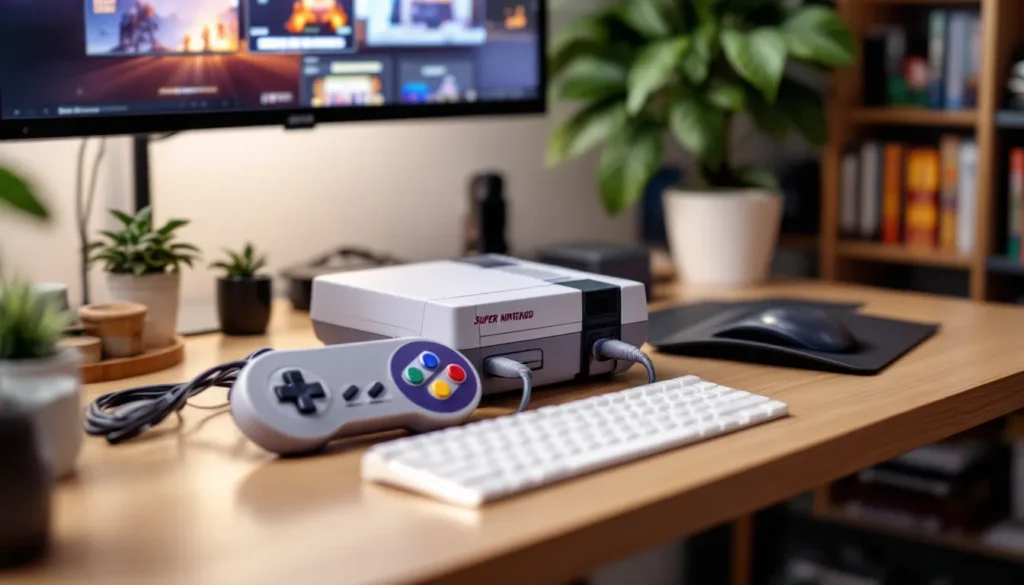
The Super Nintendo Entertainment System didn’t just compete in the 16-bit era, it dominated it. Released during one of gaming’s most heated rivalries, the SNES delivered a library so stacked with legendary titles that it’s still revered three decades later. From the pixel-perfect platforming of Super Mario World to the time-bending narrative of Chrono Trigger, Nintendo’s 16-bit powerhouse proved that technical innovation paired with masterful game design could create experiences that transcend their generation.
Whether you’re a collector hunting down complete-in-box rarities, a retro enthusiast looking to revisit childhood favorites, or a modern gamer curious about what made this console so special, understanding the SNES means understanding a pivotal chapter in gaming history. This guide covers everything from the hardware that set it apart to the best ways to play these classics in 2026.
Key Takeaways
- The Nintendo SNES dominated the 16-bit era with a library exceeding 1,400 games worldwide, establishing itself as one of the most content-rich and influential gaming platforms ever created.
- Iconic SNES titles like Chrono Trigger, Super Mario World, and Final Fantasy III set the gold standard for JRPG storytelling and 2D platformer design that developers still reference today.
- The SNES superior audio chip and Mode 7 graphics technology enabled innovations in game design and composition that fundamentally shaped modern gaming aesthetics and control schemes.
- Nintendo Switch Online offers the most affordable and legal way to play 60+ SNES games for $3.99/month, making classic titles more accessible than collecting expensive original cartridges.
- SNES collecting has shifted from speculation-focused investments to players seeking curated libraries of actually playable games, with prices stabilizing since the 2021 market peak.
- The console’s influence extends beyond its hardware to modern indie games, speedrunning culture, and fundamental game design philosophies emphasizing player tutorialization and narrative-driven experiences.
What Is the Nintendo SNES and Why Does It Matter?
The Super Nintendo Entertainment System (SNES in North America, Super Famicom in Japan) was Nintendo’s 16-bit home console that bridged the gap between the 8-bit NES era and the 3D revolution of the PlayStation and Nintendo 64. But calling it a bridge undersells its impact, the SNES represented Nintendo at the absolute peak of its 2D game development prowess.
The Birth of a Legend: SNES Release and History
Nintendo launched the Super Famicom in Japan on November 21, 1990, with a modest initial lineup that included Super Mario World and F-Zero. North American gamers got their hands on the redesigned SNES on August 23, 1991, at a launch price of $199. The European release followed in April 1992, adopting the sleeker Japanese design rather than the boxy North American aesthetic.
The console’s lifespan stretched from 1990 to 2003, yes, Nintendo officially supported the SNES well into the PS2 era, with the final licensed game, Fire Emblem: The Binding Blade, releasing in Japan in 2002. That 12-year run produced a library of over 700 games in North America and 1,400+ worldwide, cementing the SNES as one of the most content-rich platforms ever created.
Timing mattered. Sega had already established the Genesis/Mega Drive as a formidable competitor by the time SNES launched. Nintendo’s response wasn’t just hardware, it was a coordinated assault of first-party excellence and third-party partnerships that redefined what console gaming could achieve.
Technical Specifications That Set It Apart
The SNES packed a Ricoh 5A22 CPU running at 3.58 MHz (or 2.68 MHz in PAL regions), which on paper looked modest compared to the Genesis’s 7.6 MHz Motorola 68000. But raw clock speed doesn’t tell the whole story. Nintendo’s custom Picture Processing Unit (PPU) could handle more colors simultaneously, 32,768 possible colors with 256 on-screen at once, and featured Mode 7, a pseudo-3D effect that enabled the scaling and rotation effects in F-Zero, Super Mario Kart, and Pilotwings.
The audio chipset, the Sony SPC700, delivered eight-channel ADPCM sound that absolutely destroyed the Genesis’s FM synthesis in terms of sample quality. This is why SNES soundtracks, think Donkey Kong Country’s atmospheric jungle themes or Final Fantasy VI’s operatic sequences, still hold up today.
Resolution maxed out at 512×448 in interlaced mode, though most games ran at 256×224. The system supported 128 sprites on-screen with a maximum of 32 per scanline, and it included 128KB of RAM for general operations plus 64KB of video RAM and 64KB of audio RAM. These specs might seem quaint now, but developers squeezed every ounce of performance from them.
The Most Iconic SNES Games of All Time
The SNES library isn’t just good, it’s absurdly stacked. Multiple genres peaked on this system, and several franchises released their definitive entries here.
Essential RPGs: From Chrono Trigger to Final Fantasy III
Chrono Trigger (1995) remains the gold standard for JRPG storytelling. Square’s dream team, including Dragon Quest creator Yuji Horii and Dragon Ball artist Akira Toriyama, crafted a time-traveling epic with 13 different endings, a New Game+ mode before that was standard, and a combat system that still feels fresh. No random encounters, combo techs between party members, and a soundtrack by Yasunori Mitsuda that defined an era.
Final Fantasy III (actually Final Fantasy VI in Japan) pushed the SNES hardware to its absolute limits. The opera scene, the World of Ruin, Kefka’s descent into godhood, this wasn’t just a technical showcase, it was narrative ambition that most games still haven’t matched. The Active Time Battle system reached its refinement here, and the ensemble cast of 14 playable characters each brought unique abilities and story arcs.
EarthBound (1995) flopped commercially but became a cult phenomenon. Its modern setting, quirky humor, and psychedelic final boss sequence influenced everyone from Undertale’s Toby Fox to Pokémon’s designers. The game’s reputation has only grown, which explains why complete copies now sell for $500+.
Other essential RPGs include Super Mario RPG (Nintendo and Square’s surprising collaboration), Secret of Mana (real-time combat with three-player co-op), and Terranigma (a European exclusive that American collectors now pay premium prices to import).
Platform Perfection: Super Mario World and Donkey Kong Country
Super Mario World (1990) launched with the console and immediately justified the upgrade from NES. 96 exits across multiple worlds, the introduction of Yoshi as Mario’s dinosaur companion, the cape feather’s gliding mechanics, and secret Star World levels that rewarded exploration. The game sold over 20 million copies and remains the best-selling SNES title.
The level design philosophy here, tutorializing mechanics through environmental storytelling rather than text prompts, became the blueprint for 2D platformers. The way Donut Plains 1 teaches you Yoshi’s abilities without a single word is game design mastery.
Donkey Kong Country (1994) arrived late in the console’s lifecycle and shocked everyone with its pre-rendered 3D graphics created on Silicon Graphics workstations. Rare’s atmospheric jungle environments, tight controls, and punishing-but-fair difficulty made it an instant classic. The soundtrack, composed by David Wise, stands as one of gaming’s finest, Aquatic Ambience is a masterclass in mood-setting.
DKC’s success spawned two equally excellent sequels: Donkey Kong Country 2: Diddy’s Kong Quest (many consider this the trilogy’s peak) and Donkey Kong Country 3: Dixie Kong’s Double Trouble.
Fighting Game Classics: Street Fighter II and Mortal Kombat
The SNES became the definitive home for arcade fighters. Street Fighter II: Turbo and later Super Street Fighter II brought Capcom’s phenomenon home with near-arcade-perfect translations. The SNES controller’s six face buttons (compared to Genesis’s three) made special moves more accessible.
The console war got bloody with Mortal Kombat. The Genesis version kept the gore with a code, while Nintendo initially censored it with sweat instead of blood. Consumer backlash led to the uncensored Mortal Kombat II on SNES, and the ESRB rating system was partially created because of this controversy.
Other standout fighters include Killer Instinct (another Rare technical showcase), Samurai Shodown, and the often-overlooked WeaponLord, which featured frame data displays before that became standard in competitive fighting games.
Hidden Gems and Underrated Titles Worth Playing
Beyond the hall-of-famers, the SNES library hides some absolute treasures:
- Sunset Riders (1993): Konami’s run-and-gun Western that’s criminally underplayed
- Ogre Battle: March of the Black Queen (1993): Real-time strategy meets JRPG with alignment systems and branching narratives
- Demon’s Crest (1994): Capcom’s gothic action-platformer with Metroidvania elements
- Metal Warriors (1995): LucasArts’ mech combat game with competitive multiplayer that feels ahead of its time
- Zombies Ate My Neighbors (1993): LucasArts’ co-op horror comedy with 48 levels of B-movie chaos
Many of these games have become expensive collector’s items, but they’re worth experiencing through legal emulation options if originals are out of reach.
How to Play SNES Games in 2026
Retro gaming has never been more accessible, but the options vary wildly in cost, legality, and authenticity.
Finding and Buying Original SNES Consoles
Original SNES consoles still function reliably if properly maintained. Expect to pay $80-$150 for a working North American SNES with cables and a controller through eBay, local retro game shops, or Facebook Marketplace. The Japanese Super Famicom typically runs cheaper ($50-$80) and plays the same games with a simple region adapter.
Key things to check when buying used:
- Yellowing plastic: The original SNES case is notorious for discoloration due to bromine in the plastic. It’s cosmetic but affects resale value.
- Controller port functionality: Test both ports if possible.
- Power supply: Original AC adapters (Model SNS-002) output 10V DC, 850mA. Third-party replacements work but verify voltage specs.
- RF vs. composite vs. RGB: Original SNES supports composite and S-Video (with the right cable). For the best picture on modern displays, invest in an RGB SCART cable or an upscaler like the RetroTINK-5X ($300) or OSSC ($200).
The PAL SNES (European/Australian) runs games at 50Hz instead of 60Hz, causing slowdown. Avoid unless you’re specifically collecting PAL releases.
Nintendo Switch Online and Official Emulation Options
The most affordable and legal way to play SNES games in 2026 is Nintendo Switch Online. The base subscription ($3.99/month or $19.99/year) includes access to a growing library of SNES titles, currently at 60+ games including Super Metroid, The Legend of Zelda: A Link to the Past, Super Mario World, and Kirby’s Dream Land 3.
Nintendo continues adding titles quarterly, and the service includes features like save states, rewind functionality, and online multiplayer for compatible games. The Switch’s handheld mode makes it perfect for portable SNES gaming, though purists will notice slight input lag compared to original hardware.
The expansion pack tier ($49.99/year) adds N64 and Genesis games but doesn’t expand the SNES library, so base tier is all you need for 16-bit Nintendo nostalgia.
Third-Party Emulation and Legal Considerations
Emulation exists in a legal gray area. The software itself, emulators like SNES9x, bsnes, or RetroArch, is completely legal. ROM files are where things get murky.
Legally speaking, downloading ROMs of games you don’t own is copyright infringement, even if the game is out of print. The “24-hour trial” myth and “archival backup” exceptions don’t actually exist in U.S. copyright law. That said, enforcement is virtually nonexistent for personal use of decades-old games.
If you want to emulate legally:
- Rip your own cartridges using devices like the Retrode 2 ($90) or INLretro ($40).
- Use emulators on PC, Android, or jailbroken devices.
- For accuracy, bsnes (now called higan) prioritizes cycle-accurate emulation over performance.
For hardware enthusiasts, the Analogue Super Nt ($250) plays original cartridges with FPGA-based hardware emulation that’s essentially indistinguishable from original hardware, plus HDMI output at 1080p.
SNES Classic Edition: Is It Still Worth It?
Nintendo’s SNES Classic Edition launched in September 2017 for $79.99 with 21 pre-loaded games, including the never-before-released Star Fox 2. It sold out immediately and was discontinued in 2019.
On the secondary market, expect to pay $100-$150 for a complete unit. Is it worth it in 2026?
Pros:
- Plug-and-play simplicity with HDMI output
- Includes two controllers (original console only came with one)
- Star Fox 2 exclusivity (though it’s now on Switch Online)
- Solid emulation quality with save states
Cons:
- Limited library (21 games vs. 60+ on Switch Online)
- No way to legally add more games without modding
- Switch Online costs less over two years and has portability
The SNES Classic makes sense for collectors or as a display piece, but Switch Online offers better value for actually playing games. Enthusiasts covering Nintendo Switch news typically recommend the subscription route for most players.
Collecting SNES Games: What You Need to Know
SNES collecting has exploded over the past decade, transforming from a niche hobby into a serious investment market.
Most Valuable SNES Games and Market Trends
The retro game market peaked in 2021 when sealed copies of Super Mario Bros. sold for over $1 million, but SNES prices have stabilized since the pandemic bubble burst. Still, certain titles command serious money:
Top-tier rarities (loose cart prices as of early 2026):
- EarthBound with original box and guide: $800-$1,200
- Chrono Trigger: $150-$200 loose, $800+ complete
- Final Fantasy III: $120-$180 loose, $500+ complete
- Hagane: The Final Conflict: $900-$1,500 (Blockbuster exclusive)
- Mega Man X3: $200-$350 loose
- Super Metroid: $80-$120 loose
Factory-sealed games fetch 5-10x these prices, but the graded game market has cooled significantly since Wata Games and Heritage Auctions faced scrutiny over market manipulation.
Several factors drive SNES prices:
- Print runs: Games released late in the console’s lifecycle (1996-1998) had smaller production runs.
- Rental exclusives: Titles only available through Blockbuster or Hollywood Video are inherently rarer.
- Regional differences: European exclusive RPGs like Terranigma command premium prices in North America.
- Condition: Cartridge label quality matters enormously. Sun fading, tears, and marker writing tank value.
The market has shifted toward playability over speculation. Collectors in 2026 are less interested in sealed investments and more focused on building curated libraries of games they’ll actually play. Coverage from outlets specializing in Japanese gaming news shows similar collecting trends in the Super Famicom market.
Spotting Reproductions and Protecting Your Investment
Reproduction cartridges flood the market, especially for high-value titles. Here’s how to identify them:
Physical tells:
- Screw types: Original SNES carts use proprietary gamebit screws. Phillips-head screws are an immediate red flag.
- Cartridge weight: Repros often feel lighter due to different PCB materials.
- Label quality: Reproductions use modern printing that looks too sharp and vibrant compared to period-correct labels.
- Shell plastic: Original carts have a specific texture and color tone that repros struggle to match.
Internal verification:
- Open the cart (requires a 3.8mm gamebit screwdriver).
- Check for the official Nintendo logo stamped on the PCB.
- Verify the chip configuration. EarthBound, for example, uses a MAD-1 chip. Repros use generic flash memory.
- Look for factory solder points. Repro PCBs often have messy, hand-soldered connections.
Market protection strategies:
- Buy from reputable sellers with return policies.
- Check seller ratings and specifically look for reviews mentioning authenticity.
- For expensive purchases ($200+), ask for internal photos before buying.
- Use PriceCharting.com to verify current market values.
- Consider condition honestly. A $30 cart in poor condition isn’t magically worth $200 because of the title.
Insurance matters too. Standard homeowner’s or renter’s insurance often caps collectibles coverage at $1,000-$2,000 total. If your collection exceeds that, look into specialty collectibles insurance from companies like Collectibles Insurance Services.
The SNES vs. Sega Genesis: The Console War That Defined a Generation
The 16-bit console war wasn’t just marketing, it represented fundamentally different philosophies about what gaming should be.
Sega positioned the Genesis as the cool, edgy alternative with “Blast Processing” (marketing nonsense, but effective) and Sonic the Hedgehog’s attitude-driven mascot. Nintendo countered with hardware advantages, deeper gameplay experiences, and an ironclad lineup of first-party franchises.
The technical comparison favored different strengths. Genesis had a faster CPU clock speed and excelled at fast-paced action games, Sonic’s speed, Streets of Rage’s scrolling brawls, and Gunstar Heroes’ on-screen chaos. SNES had superior color depth, better audio, and Mode 7 effects that enabled gameplay innovations Genesis couldn’t match.
Third-party support became the real battleground. Capcom initially supported both platforms equally, but titles like Street Fighter II and Mega Man X performed better on SNES. Square remained Nintendo-exclusive throughout the 16-bit era, giving SNES the undisputed JRPG crown. Meanwhile, Genesis landed exclusive deals with EA for sports titles and built a stronger library of Western-developed games.
Sales figures tell an interesting story. Globally, SNES sold approximately 49.1 million units compared to Genesis’s 30.75 million. But in North America, the primary battleground, the race was much closer, with some estimates putting Genesis slightly ahead. Japan overwhelmingly favored Super Famicom.
The war’s legacy extends beyond the consoles themselves. It established gaming as a mainstream entertainment medium, proved that platform competition drives innovation, and created a generation of passionate fans who still argue about Mode 7 versus blast processing in 2026.
Both consoles won in their own ways. Genesis pushed gaming toward mature content and aggressive marketing. SNES refined 2D game design to an art form that developers still reference today. Platforms covering RPG reviews consistently rank SNES RPGs among the greatest games ever made, a testament to the console’s enduring software quality.
Why the SNES Still Influences Modern Gaming
The SNES didn’t just produce great games, it established design principles that developers still follow three decades later.
Control schemes became standardized. The SNES controller’s shoulder buttons, diamond face button layout, and ergonomic grip directly influenced the PlayStation controller, which evolved into the industry standard. Every modern controller from Xbox to Switch traces its lineage back to Nintendo’s 16-bit design.
Mode 7 evolved into 3D gaming. Games like F-Zero and Super Mario Kart weren’t true 3D, but they taught developers and players how to navigate virtual space from different perspectives. The jump to PlayStation and N64 felt less jarring because SNES had already introduced the concepts.
Soundtracks became compositional, not just functional. The SNES audio chip allowed composers like Nobuo Uematsu, Koji Kondo, and David Wise to create layered, emotionally resonant music. Modern game soundtracks, whether orchestral or electronic, follow the narrative integration pioneered on SNES.
Game design tutorialization through environment. Super Mario World’s opening levels, Mega Man X’s introductory highway stage, and The Legend of Zelda: A Link to the Past’s castle escape all teach mechanics through design rather than text. This “show, don’t tell” philosophy dominates modern game development, from Dark Souls to Breath of the Wild.
JRPGs found their identity. The genre’s core elements, turn-based combat, character-driven narratives, world maps with explorable towns, equipment management, and dramatic story beats, crystallized on SNES. Even modern JRPGs like Persona 5 and Octopath Traveler reference SNES design sensibilities.
Speedrunning culture began here. The precision required for SNES platformers, the tight execution windows in action games, and the depth of sequence-breaking in titles like Super Metroid made these games perfect for competitive speedrunning. Games Done Quick events regularly feature SNES titles because they remain technically demanding and entertaining to watch.
Indie developers continue mining SNES aesthetics and mechanics. Shovel Knight, Celeste, Hollow Knight, and Undertale all borrow visual styles, control schemes, or design philosophies from 16-bit classics. The pixel art renaissance in indie gaming is essentially a love letter to the SNES era.
The console’s influence extends to game preservation conversations. The success of SNES Classic Edition and Nintendo Switch Online proved that retro gaming isn’t just nostalgia, there’s genuine demand for access to classic games. This has pushed the industry toward backward compatibility and subscription-based retro libraries as standard features.
Conclusion
The Super Nintendo Entertainment System earned its legendary status through a combination of technical excellence, unmatched software quality, and perfect timing. While the console wars raged, Nintendo quietly built a library so strong that gamers still argue about which era produced better games, and SNES always enters that conversation.
Whether you’re playing on original hardware with an upscaler, enjoying the convenience of Switch Online, or hunting down complete-in-box rarities for your collection, the SNES offers something no amount of polygons or ray tracing can replicate: perfectly executed game design that respects the player’s time and intelligence.
The 16-bit era ended over two decades ago, but the SNES remains essential gaming history. Not because of nostalgia, because the games are still that good.